Support our educational content for free when you purchase through links on our site. Learn more
What Is the Difference Between Game, Gaming & Gamification? 🎮 (2026)

Confused about the buzzwords game, gaming, and gamification? You’re not alone! These terms often get tangled up, but understanding their unique meanings is crucial—whether you’re a teacher, marketer, business leader, or just a curious gamer. Did you know the global gamification market is expected to surpass $40 billion by 2026? That’s a lot of game elements powering real-world change!
In this article, we’ll unravel the mystery behind these terms, explore their history, and highlight 7 key differences that set gaming and gamification worlds apart. Plus, we’ll dive into how serious games fit into the puzzle and share expert tips for using gamification authentically. Stick around for our deep dive into popular gamification techniques and the tools that bring them to life. Ready to level up your understanding? Let’s go!
Key Takeaways
- Game is a structured activity with rules, goals, and challenges designed primarily for entertainment or education.
- Gaming refers to the act of playing games, encompassing everything from casual mobile play to competitive esports.
- Gamification applies game elements like points and badges to non-game contexts to boost engagement and motivate behavior.
- Serious Games are full games designed with a purpose beyond entertainment, often for training or education.
- Understanding these distinctions helps you choose the right approach for learning, marketing, or productivity goals.
- Effective gamification blends intrinsic motivation with meaningful rewards and integrates seamlessly into user experiences.
Ready to transform your approach with game-inspired strategies? Keep reading to discover how to gamify everything—without losing authenticity!
Table of Contents
- ⚡️ Quick Tips and Facts
- 🎮 Gaming, Gamification, and Game: Defining the Core Concepts
- 📜 The Evolution and History of Gaming and Gamification
- 🔍 What Is Gaming? Exploring Video Games, Board Games, and More
- 🕹️ What Is a Game? Understanding Game Mechanics and Elements
- 🏆 What Is Gamification? Turning Non-Game Contexts Into Engaging Experiences
- 🆚 Gaming vs. Gamification: 7 Key Differences You Need to Know
- 🎯 How Gamification Boosts Engagement in Business, Education, and Health
- 🎲 Serious Games vs. Gamification: 4 Differences That Set Them Apart
- ⚙️ Popular Gamification Techniques and Game Design Elements Explained
- 📈 Measuring Success: How to Track the Impact of Gamification and Gaming
- 🛠️ Tools and Platforms for Gamification and Game Development
- 💡 Tips for Implementing Gamification Without Losing Authenticity
- 🤔 Common Misconceptions About Gaming and Gamification Debunked
- 📚 Recommended Resources and Further Reading on Gaming and Gamification
- 🔚 Conclusion: Mastering the Art of Gaming and Gamification
- 🔗 Recommended Links
- ❓ FAQ
- 📑 Reference Links
⚡️ Quick Tips and Facts
Alright, fellow engagement enthusiasts! Before we dive deep into the fascinating world of digital interaction, let’s get some quick facts straight. Think of this as your cheat sheet for understanding the core differences between game, gaming, and gamification. Ready? Let’s roll! 🚀
- Game: ✅ A structured form of play, usually undertaken for enjoyment, and sometimes used as an educational tool. It has defined rules, goals, challenges, and often involves competition or cooperation. Think chess, Monopoly, or even a simple game of tag!
- Gaming: ✅ The act of playing games. This is the activity itself, encompassing everything from casual mobile puzzle-solving to competitive esports tournaments. It’s about the player’s experience within a game world.
- Gamification: ✅ Applying game design elements and game thinking to non-game contexts to engage users and solve problems. It’s not a game itself, but it uses game-like mechanics to motivate behavior in areas like education, business, or health. Think loyalty programs, fitness apps, or learning platforms.
- Serious Games: ❌ Not gamification. These are full games designed with a primary purpose beyond pure entertainment, such as training, education, or simulation. They have a beginning, middle, and end, and often require a debriefing.
- Game-Based Learning: ✅ A specific application of Serious Games where the entire learning experience is built around playing a game. The learning is the game.
- Key Distinction: Gaming is about playing games for entertainment. Gamification is about making non-game activities feel like games to drive engagement. Serious Games are games, but with a serious purpose.
🎮 Gaming, Gamification, and Game: Defining the Core Concepts
Ever found yourself scratching your head, wondering if “gaming,” “gamification,” and “game” are just fancy synonyms for the same thing? You’re not alone! It’s a common point of confusion, even for seasoned pros. But fear not, because here at Gamification Hub™, we’re about to unravel this linguistic knot and set the record straight. Understanding these distinctions is crucial, especially if you’re looking to harness the power of play for real-world impact.
At its core, the difference lies in intent, context, and the level of immersion. Are we talking about pure entertainment, a structured activity, or a strategic application of game principles to everyday life? Let’s dive in and define these fundamental concepts, paving the way for a deeper understanding of how they intersect and diverge. For a more in-depth look at how these concepts relate to learning, check out our article on What is the Difference Between Gaming, Game-Based Learning, and Gamification? 2023.
📜 The Evolution and History of Gaming and Gamification

The human fascination with games is as old as civilization itself. From ancient board games like Senet in Egypt (around 3100 BC) to the strategic depths of Go in China (over 2,500 years ago), games have always been a fundamental part of human culture, serving roles in entertainment, ritual, and even military strategy.
The Dawn of Digital Play: From Arcades to Esports
The concept of “gaming” as we know it truly exploded with the advent of digital technology.
- Early Days (1950s-1970s): The first electronic games like Tennis for Two (1958) and Spacewar! (1962) were academic curiosities. Then came the arcade boom with Pong (1972) and the first home console, the Magnavox Odyssey.
- The Golden Age (1980s): Iconic titles like Pac-Man, Donkey Kong, and Super Mario Bros. captivated millions, establishing video games as a mainstream entertainment medium.
- Modern Era (1990s-Present): The rise of powerful consoles (PlayStation, Xbox, Nintendo), PC gaming, and eventually mobile gaming transformed the landscape. Online multiplayer, virtual reality, and the phenomenon of esports have cemented gaming’s place as a global cultural and economic powerhouse. Today, the global video game market is projected to reach over $200 billion, according to Statista [1].
The Emergence of Gamification: From Loyalty Programs to Behavior Change
While the term “gamification” was coined relatively recently (around 2002 by Nick Pelling), the principles behind it have been around for ages. Think about scout badges, frequent flyer miles, or even gold stars in elementary school – these are all early forms of applying game-like rewards to motivate desired behaviors.
- Pre-Digital Roots: Loyalty programs, like S&H Green Stamps (introduced in 1896!), were pioneers in using points and rewards to influence consumer behavior. These systems tapped into our innate desire for achievement and recognition.
- The Digital Renaissance (2000s): With the rise of the internet and mobile technology, the application of game elements became more sophisticated and widespread. Companies like Foursquare (launched 2009) popularized badges and leaderboards for real-world check-ins, demonstrating the power of digital gamification.
- Academic and Business Adoption: By the early 2010s, gamification gained significant traction in academic research and corporate strategy. Thought leaders like Yu-kai Chou with his Octalysis Framework and Karl Kapp with his focus on instructional gamification began to formalize the field. As Kapp notes, gamification is about “using game-based mechanics, aesthetics, and game thinking to engage people, motivate action, promote learning, and solve problems” [2].
Our team at Gamification Hub™ has witnessed this evolution firsthand. I remember working on an early project in the mid-2000s, trying to motivate employees to complete compliance training. We introduced a simple leaderboard and “achievement badges” for modules completed. The engagement skyrocketed! It wasn’t a full game, but those small game elements made a tedious task feel like a challenge to conquer. It was a lightbulb moment for many of us, realizing the immense potential of this approach.
🔍 What Is Gaming? Exploring Video Games, Board Games, and More
So, what exactly is gaming? Simply put, gaming is the act of playing games. It’s the immersive experience, the challenge, the social interaction, and often, the pure joy derived from engaging with a structured play environment. It’s a vast universe, encompassing everything from ancient strategy games to cutting-edge virtual reality experiences.
The Diverse Landscape of Gaming
Gaming isn’t just about staring at a screen. It’s a multifaceted hobby and industry that caters to every taste and preference.
- Video Games: This is probably what most people think of when they hear “gaming.”
- Console Gaming: Platforms like Sony PlayStation 5, Microsoft Xbox Series X, and Nintendo Switch offer high-fidelity graphics and exclusive titles. My personal anecdote: I spent countless hours on my Nintendo 64 playing The Legend of Zelda: Ocarina of Time. That sense of adventure and discovery is what hooked me on gaming for life!
- PC Gaming: Often lauded for its graphical prowess, customization, and competitive esports scene. Platforms like Steam (Valve Corporation) offer a massive library of games.
- Mobile Gaming: Dominating the casual market, games like Candy Crush Saga (King) and Pokémon GO (Niantic) are accessible to billions via smartphones and tablets.
- Cloud Gaming: Services like Xbox Cloud Gaming and NVIDIA GeForce NOW allow players to stream games without powerful hardware, making high-end gaming more accessible.
- Board Games: A resurgence in popularity has brought complex and engaging titles like Catan (Klaus Teuber), Ticket to Ride (Alan R. Moon), and Gloomhaven (Isaac Childres) to the forefront. These offer rich social interaction and strategic depth.
- Card Games: From traditional playing cards (Poker, Bridge) to modern collectible card games like Magic: The Gathering (Wizards of the Coast) and Hearthstone (Blizzard Entertainment), card games combine strategy, luck, and social dynamics.
- Role-Playing Games (RPGs): Whether tabletop (like Dungeons & Dragons) or digital (The Witcher 3: Wild Hunt), RPGs allow players to embody characters and explore rich narrative worlds.
- Arcade Games: While less prevalent today, the classic arcade experience with games like Space Invaders and Street Fighter laid the groundwork for competitive gaming.
Why Do We Game? The Psychology of Play
The appeal of gaming is deeply rooted in human psychology.
- Challenge and Mastery: Games provide clear goals and obstacles, offering a sense of accomplishment upon overcoming them.
- Escapism and Immersion: They transport us to different worlds, allowing us to temporarily step away from reality.
- Social Connection: Multiplayer games foster teamwork, competition, and community.
- Learning and Skill Development: Many games require strategic thinking, problem-solving, and quick reflexes, honing cognitive skills.
- Emotional Release: Games can evoke a wide range of emotions, from excitement and joy to frustration and triumph.
As gamification engineers, we study these intrinsic motivators to understand why games are so engaging. This understanding is key to effectively applying game principles in non-game contexts.
🕹️ What Is a Game? Understanding Game Mechanics and Elements
Before we can truly grasp gamification, we need to nail down the fundamental question: What is a game? It might seem obvious, but defining “game” precisely helps us differentiate it from mere play or a simple toy. According to Katie Salen and Eric Zimmerman in Rules of Play: Game Design Fundamentals, a game is “a system in which players engage in an artificial conflict, defined by rules, that results in a quantifiable outcome” [3].
Let’s break down the essential elements that constitute a game:
Core Elements of Any Game
- Goals: Every game has one or more objectives that players strive to achieve. This could be winning, scoring points, reaching an endpoint, or solving a puzzle. Without a goal, it’s just aimless activity.
- Rules: These are the constraints that define how players can act and interact within the game. Rules create structure, fairness, and challenge. They dictate what is allowed, what is forbidden, and how actions translate into outcomes.
- Challenges/Obstacles: Games present difficulties that players must overcome to achieve their goals. These can be opponents, puzzles, time limits, or resource management tasks. The challenge is what makes the game engaging and rewarding.
- Feedback Systems: Players need to know how they’re performing. This comes in the form of points, scores, levels, progress bars, visual cues, or immediate consequences for actions. Effective feedback is crucial for learning and motivation.
- Voluntary Participation: Players choose to engage in a game. This voluntary nature is key to its appeal; the fun comes from opting into the challenge.
- Interaction: Games involve interaction, either between players (competitive or cooperative) or between a player and the game system itself.
- Quantifiable Outcome: There’s usually a clear win/loss state, a score, or some measurable result that determines the game’s conclusion.
Games vs. Play vs. Toys: A Crucial Distinction
The gamified.uk summary highlights a critical differentiation that we often emphasize at Gamification Hub™: the spectrum of games, play, and toys.
| Feature | Play | Game | Toy |
|---|---|---|---|
| Purpose | Free-form enjoyment, exploration, creativity | Achieve defined goals, overcome challenges, entertainment | Object for play, open-ended interaction |
| Rules | Implicit, self-imposed, fluid | Explicit, structured, fixed | Implicit rules based on object’s nature |
| Goals | No explicit goals, process-oriented | Clear objectives, win/loss conditions, quantifiable outcomes | No inherent goals, user defines purpose |
| Structure | Unstructured, spontaneous | Highly structured, defined beginning and end | Object-centric, provides tools for play/games |
| Engagement | Intrinsic, imaginative | Intrinsic (mastery, challenge) & Extrinsic (rewards, competition) | Intrinsic, exploratory |
| Example | Child running around in a park | Chess, Fortnite, Monopoly | A doll, building blocks, a ball |
Our Take: A game is a structured activity with rules and goals. Play is a free-form, enjoyable activity without strict rules or goals. A toy is an object that facilitates play or can be used within a game. Understanding this hierarchy is fundamental to designing effective gamified experiences. You can’t gamify something if you don’t know what makes a game tick!
🏆 What Is Gamification? Turning Non-Game Contexts Into Engaging Experiences
Now for the star of our show: Gamification! This is where our expertise at Gamification Hub™ truly shines. Forget what you think you know about games; gamification isn’t about building a full-blown video game. Instead, it’s about strategically sprinkling game design elements and game thinking into non-game contexts to drive engagement, motivate behavior, and solve real-world problems.
As the “first YouTube video” embedded in this article aptly puts it, “Gamification is an umbrella term, basically meaning let’s take bits and pieces and parts of games and let’s use them in non-game settings.” It’s about leveraging the psychological triggers that make games so compelling and applying them to areas like education, marketing, health, and workplace productivity.
The Core Idea: Motivation Through Playful Design
The elearningindustry.com summary defines gamification as an “instructional design method that incorporates gaming elements into non-game environments.” This is spot on. We’re not creating games; we’re making existing activities feel more game-like.
Think about it: Why do we spend hours trying to level up in a video game, but dread filling out a tedious online form? The form lacks the immediate feedback, the sense of progress, the clear goals, and the potential for reward that a game offers. Gamification aims to inject these missing ingredients.
Key Characteristics of Gamification
- Non-Game Context: This is the defining feature. Gamification applies to tasks, systems, or environments that are not inherently games. Examples include learning management systems, customer loyalty programs, fitness apps, or employee training modules.
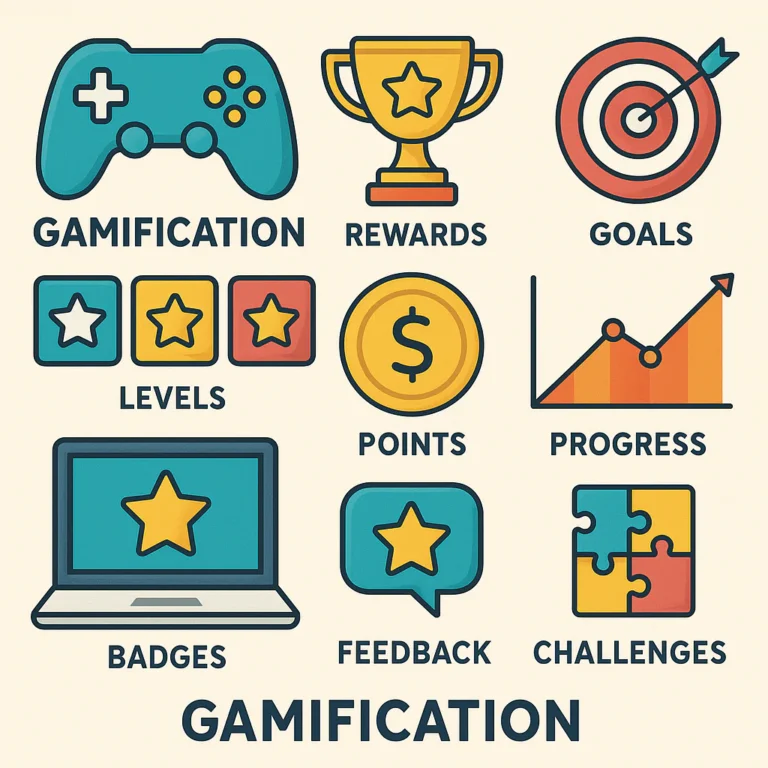
- Game Elements: It uses specific components borrowed from games. We’re talking about points, badges, leaderboards, progress bars, levels, virtual currency, quests, and challenges. These are the building blocks.
- Behavioral Motivation: The ultimate goal is to influence user behavior. Do you want users to complete their profiles? Learn a new language? Exercise more? Gamification provides the motivational nudge. This often ties into Behavior Science, understanding what drives human action.
- Engagement: By making tasks more enjoyable and rewarding, gamification significantly boosts user engagement and participation.
- Problem-Solving: It’s a powerful tool for solving real-world challenges, from improving customer retention to fostering healthier habits.
Real-World Gamification Examples We Love
- Duolingo: This language-learning app is a masterclass in gamification. It uses points (XP), streaks, levels, leaderboards, and virtual currency to keep users motivated. My colleague, Sarah, used Duolingo to learn Spanish, and she swears by its gamified approach. “It felt less like studying and more like a daily challenge to beat my friends on the leaderboard!” she shared.
- Starbucks Rewards: A classic loyalty program that uses points (Stars), tiers (Green, Gold), and personalized challenges to encourage repeat purchases and engagement.
- Nike Run Club: Tracks runs, offers guided runs, awards badges for milestones, and allows users to compete with friends. It turns running into a personal quest.
- LinkedIn Profile Completion Bar: Remember that progress bar encouraging you to fill out more of your profile? That’s a simple, yet effective, gamified element driving user action. The “first YouTube video” highlights a social media company using a progress bar to achieve a 30% increase in profile completions – a testament to its power!
Gamification is about understanding the Game Mechanics that make games so compelling and then thoughtfully integrating them into everyday experiences. It’s not about making everything a game, but about making everything more engaging.
🆚 Gaming vs. Gamification: 7 Key Differences You Need to Know
Alright, let’s get down to brass tacks. You’ve got the definitions, you’ve seen the history, but how do “gaming” and “gamification” truly stack up against each other? This is where the rubber meets the road, and understanding these distinctions is paramount for anyone looking to leverage game-like approaches effectively. Our team at Gamification Hub™ constantly navigates these differences when designing solutions, and we’ve distilled them into 7 crucial points.
Here’s a comprehensive comparison to clarify the landscape:
| Feature | Gaming | Gamification |
|---|---|---|
| 1. Primary Purpose | Entertainment, recreation, escapism. The game is the goal. | Motivation, engagement, behavior change, problem-solving. The game elements serve a non-game goal. |
| 2. Context | Within a defined game world/system. Players are in a game. | Non-game environments. Applied to existing tasks, processes, or systems. |
| 3. Immersion Level | High. Aims to create a complete, immersive experience. | Low to moderate. Adds game elements, not a full immersive world. |
| 4. Core Activity | Playing a game. The activity itself is the game. | Performing a non-game task. Game elements enhance an existing activity. |
| 5. Outcome Focus | Winning/losing, achieving in-game objectives, enjoyment. | Real-world outcomes (e.g., learning, sales, health improvement, task completion). |
| 6. Debriefing | Generally not required. The experience is self-contained. | Typically not part of the core design, as the activity isn’t a full game. (Contrast with Serious Games/Game-Based Learning, which often require it, as noted in the “first YouTube video” summary). |
| 7. User Choice | Voluntary participation in the game for its own sake. | Voluntary engagement with game elements to achieve a non-game objective. Users might have to do the task, but gamification makes it more appealing. |
Let’s elaborate on a few of these key differences, drawing from expert perspectives:
1. Primary Purpose: Fun vs. Function
The most fundamental divergence lies in their core intent. Gaming’s raison d’être is entertainment. When you pick up a Nintendo Switch to play The Legend of Zelda: Tears of the Kingdom, your primary goal is to have fun, explore, and experience the narrative.
Gamification, however, has a functional purpose. As elearningindustry.com states, Serious Games are “designed to teach and not entertain but can still be engaging,” while gamification “seeks to increase engagement and participation in non-game activities.” We use gamification to make a tedious onboarding process more engaging, or to encourage users to complete their profiles on a social media platform, as highlighted in the “first YouTube video.” The fun is a means to an end, not the end itself.
2. Context: Game World vs. Real World
Gaming exists within a self-contained “magic circle” – a space where the rules of the game apply. When you’re playing Call of Duty (Activision), you’re in a virtual battlefield.
Gamification, conversely, operates in the real world. It takes elements from that magic circle and applies them to your everyday life or work. Think of the progress bar on your LinkedIn profile, encouraging you to add more details. That’s gamification in a professional, non-game context.
3. Immersion Level: Deep Dive vs. Light Touch
Games, especially modern video games, strive for deep immersion. They build elaborate worlds, characters, and narratives to draw you in completely.
Gamification, on the other hand, is a lighter touch. It uses specific game elements (points, badges, leaderboards) to enhance an existing experience, but it doesn’t aim to create a full, immersive game world. You’re still doing your taxes, but maybe a progress bar makes it feel less daunting.
6. Debriefing: A Critical Distinction
This point is particularly relevant when comparing gamification to Game-Based Learning or Serious Games. The “first YouTube video” summary clearly states: “Gamification typically doesn’t have a debriefing, but game-based learning does.”
- Gaming: No debriefing needed; the experience is the reward.
- Gamification: No debriefing needed; the goal is to motivate a non-game action, not to reflect on a game experience.
- Serious Games/Game-Based Learning: Often require a debriefing session to connect the in-game learning to real-world application, ensuring the educational objectives are met. This is a crucial pedagogical step.
Understanding these differences is key to choosing the right tool for your engagement challenge. Are you aiming for pure fun, or are you trying to motivate a specific behavior in a non-game setting? The answer dictates your approach.
🎯 How Gamification Boosts Engagement in Business, Education, and Health
The beauty of gamification lies in its versatility. By tapping into fundamental human motivators like achievement, competition, social connection, and mastery, it can dramatically boost engagement across diverse sectors. Here at Gamification Hub™, we’ve seen firsthand how a well-designed gamified experience can transform apathy into enthusiasm. Let’s explore some compelling applications.
1. Business: Driving Performance and Customer Loyalty
In the corporate world, gamification is a powerful tool for enhancing employee engagement, training, and customer retention.
- Employee Training & Onboarding: Traditional training can be dull. Gamification injects fun and motivation.
- Example: Deloitte famously gamified its leadership training program, using badges, leaderboards, and quests. This led to a 47% increase in returning users and a 37% increase in completion rates for the program [4]. Our own Gamification Case Studies often highlight similar successes in corporate learning.
- Benefit: Employees are more likely to complete modules, retain information, and apply new skills when the learning process is engaging.
- Sales Performance: Sales teams thrive on competition.
- Example: Companies use gamified dashboards with points for calls made, deals closed, and leaderboards to foster healthy competition and motivate sales reps. Salesforce offers gamification features within its CRM to drive user adoption and productivity.
- Benefit: Increased motivation, higher sales figures, and improved team morale.
- Customer Loyalty Programs: Turning transactions into an ongoing game.
- Example: Starbucks Rewards uses a tiered system (Green, Gold) and “Stars” (points) to incentivize repeat purchases. Customers enjoy the feeling of earning rewards and progressing through levels.
- Benefit: Increased customer retention, higher average spend, and stronger brand loyalty.
- Marketing & Brand Engagement:
- Example: McDonald’s Monopoly game is a classic example, using collectible game pieces to drive purchases and create excitement around the brand.
- Benefit: Increased brand awareness, customer interaction, and sales.
2. Education: Making Learning Irresistible
Education is a natural fit for gamification, transforming passive learning into active participation. The uwaterloo.ca summary notes that both gamification and game-based learning “promote engagement but do not necessarily improve learning outcomes” without thoughtful design. This is a crucial point: it’s not just about adding points, but about designing for meaningful engagement.
- Classroom Engagement:
- Example: Tools like Kahoot! (getkahoot.com) turn quizzes into competitive, interactive games, boosting student participation and making review sessions fun. My colleague, David, a former teacher, swears by Kahoot! for keeping his students on their toes. “The energy in the room was palpable when the timer started!” he recalls.
- Benefit: Increased attention, better recall, and a more positive learning environment.
- Online Learning Platforms:
- Example: Duolingo (duolingo.com) uses streaks, levels, leaderboards, and virtual currency to motivate language learners. Coursera (coursera.com) incorporates badges and progress tracking for course completion.
- Benefit: Higher course completion rates, sustained motivation, and a sense of achievement for learners.
- Skill Development:
- Example: Platforms like Codecademy gamify coding education with interactive lessons, badges for completing modules, and progress tracking.
- Benefit: Encourages consistent practice and provides clear milestones for skill acquisition.
For more insights into how game elements can transform learning, explore our category on Educational Gamification.
3. Health & Wellness: Nudging Towards Healthier Habits
Gamification is incredibly effective in encouraging positive health behaviors, often by making mundane routines more engaging.
- Fitness Apps:
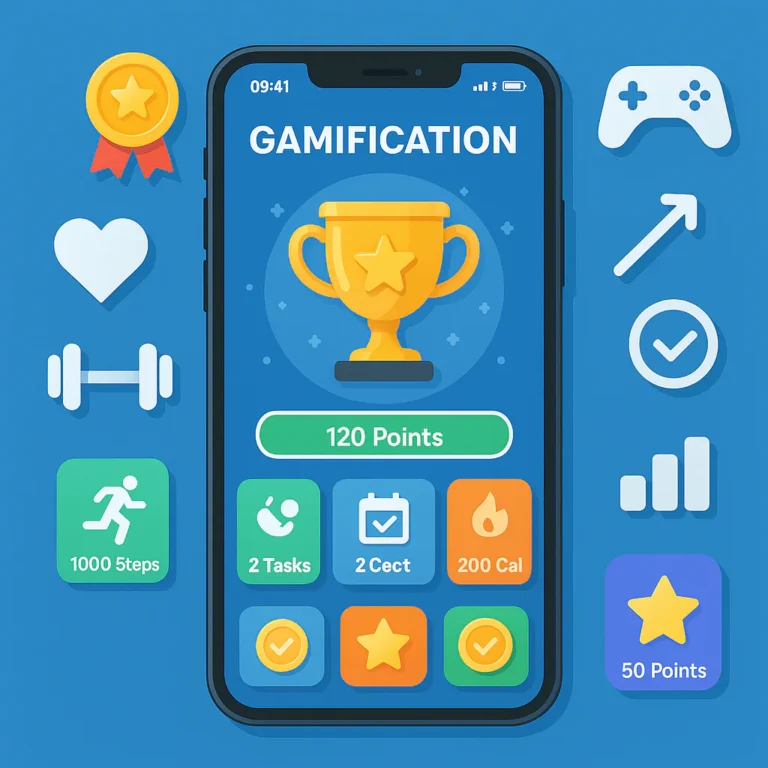
- Example: Fitbit and MyFitnessPal use points, badges for hitting step goals, challenges with friends, and progress tracking to motivate users to exercise more and eat healthier.
- Benefit: Increased physical activity, improved dietary habits, and sustained motivation for long-term wellness goals.
- Medication Adherence:
- Example: Apps like Mango Health use reminders, points, and rewards to encourage patients to take their medication on time.
- Benefit: Improved patient compliance, better health outcomes, and reduced healthcare costs.
- Mental Well-being:
- Example: Apps like SuperBetter (Jane McGonigal) frame personal health goals as “quests” to build resilience and achieve personal growth.
- Benefit: Empowers individuals to take an active role in their mental health journey.
In each of these sectors, gamification isn’t just about adding points; it’s about understanding the user’s journey, identifying motivational gaps, and strategically applying game elements to create a more engaging and rewarding experience.
🎲 Serious Games vs. Gamification: 4 Differences That Set Them Apart
This is another area where the lines can get blurry, but it’s crucial to distinguish between Serious Games and Gamification. While both leverage game-like principles for non-entertainment purposes, they are fundamentally different in their structure, intent, and execution. The elearningindustry.com summary provides an excellent framework for understanding these distinctions, and we at Gamification Hub™ wholeheartedly agree with its core tenets.
Remember the “first YouTube video” that explained gamification as using “bits and pieces” of games? Serious Games are the whole game. They are a complete, self-contained experience.
Let’s break down the four key differences:
1. Primary Purpose: Game for Learning vs. Elements for Engagement
- Serious Games: Their primary purpose is to transform training tasks into immersive, game-like experiences for education or skill development. The learning is embedded within the game itself. As
elearningindustry.comstates, “They are designed to teach and not entertain but can still be engaging.”- Example: A flight simulator used to train pilots. The entire experience is a game designed to teach specific skills.
- Gamification: Seeks to increase engagement and participation in non-game activities by applying game elements. The primary activity is not a game, but it’s made more engaging through game elements.
- Example: Adding a progress bar to an online course to encourage completion. The course itself isn’t a game.
2. Level of Gaming Elements: Full Game vs. Select Elements
- Serious Games: Contain a full suite of game elements, including graphics, storylines, rules, characters, controls, and a defined narrative arc. They are structured like traditional games.
- Example: Foldit (University of Washington), a puzzle video game about protein folding, where players contribute to scientific research. It has a full game interface, rules, and objectives.
- Gamification: Uses specific elements like leveling up, badges, leaderboards, points, and virtual rewards to make tasks feel game-like. It focuses on motivating through these mechanics rather than creating a complete game experience.
- Example: A fitness app giving you a badge for running 5k. The app isn’t a game, but the badge is a game element.
3. Engagement and Rewards: Embedded Achievement vs. Explicit Motivators
- Serious Games: Completion of the game itself signifies achievement, and rewards are often embedded subtly within the gameplay or through the acquisition of skills. The intrinsic satisfaction of mastering the game’s challenge is a key reward.
- Example: Successfully completing a complex medical simulation means you’ve learned a critical procedure. The reward is the acquired skill and confidence.
- Gamification: Rewards (badges, points, levels) are often explicit motivators designed to foster competition and a sense of achievement in a non-game context. They are often external incentives.
- Example: Earning points for completing a customer survey, which can then be redeemed for a discount.
4. Applications in Learning & Development: Immersive Skill Building vs. Ongoing Motivation
- Serious Games: Used for quick topic introduction or immersive, long-form skill development. They provide a safe environment for practice and experimentation.
- Example: A virtual reality game designed to teach surgical procedures or crisis management.
- Gamification: Primarily used to maintain motivation and track progress throughout courses or long-term activities. It enhances engagement and provides ongoing incentives for sustained effort.
- Example: A learning management system that awards badges for completing each module of a year-long certification program.
The Overlap with Game-Based Learning
It’s important to note that Game-Based Learning (GBL) is essentially a subset of Serious Games, specifically focused on educational outcomes. As the uwaterloo.ca summary explains, “Game-based learning designs learning activities that are intrinsically game-like.” The “first YouTube video” also clarifies that GBL is “an entire system designed around achieving a learning goal,” complete with a defined beginning, middle, end, and a debriefing process.
| Feature | Serious Games | Gamification |
|---|---|---|
| What it is | A full, self-contained game | Application of game elements to non-game contexts |
| Core Purpose | Learning, training, simulation, awareness (primary goal beyond entertainment) | Engagement, motivation, behavior change (in existing activities) |
| Structure | Has a narrative, characters, rules, graphics, beginning, middle, end | Adds points, badges, leaderboards, progress bars to existing activities |
| Player Role | Player is in a game | User performs a task, enhanced by game elements |
| Debriefing | Often required to connect game experience to real-world learning | Generally not required |
| Example | Flight simulator, Foldit, Minecraft: Education Edition | Duolingo streaks, Starbucks Rewards, LinkedIn profile completion bar |
Our Recommendation: Deciding between Serious Games and Gamification (or even Game-Based Learning) depends entirely on your objectives. As elearningindustry.com concludes, “Deciding which one to use or how to combine them depends on your subject matter, goals, and employee needs.” If you need a fully immersive, experiential learning environment, a Serious Game might be your answer. If you want to boost motivation and engagement within an existing process, gamification is your go-to. Both are powerful, but they serve different strategic roles. For more on this, check out our Game-Based Learning resources.
⚙️ Popular Gamification Techniques and Game Design Elements Explained
At Gamification Hub™, we’re like master chefs, carefully selecting the right ingredients (game elements) to create a delicious and engaging experience (gamified system). It’s not just about throwing points at everything; it’s about understanding the psychology behind each element and how it influences user behavior. These are the fundamental building blocks of any successful gamification strategy. For a deeper dive into the nuts and bolts, check out our Game Mechanics category.
Let’s explore the most popular and effective gamification techniques:
1. Points (Experience Points – XP) 🌟
- What they are: Numerical values awarded for completing tasks, achieving milestones, or demonstrating desired behaviors.
- How they work: Points provide immediate feedback and a quantifiable measure of progress. They tap into our desire for achievement and can be accumulated to unlock other rewards.
- Benefits:
- Clear Progress: Users see their efforts translated into a tangible score.
- Flexibility: Can be awarded for almost any action.
- Foundation: Often the base for other elements like levels and leaderboards.
- Drawbacks:
- Can become meaningless if not tied to clear value or progression.
- Can encourage “grinding” for points rather than genuine engagement.
- Example: Earning XP in Duolingo for completing lessons.
2. Badges & Achievements 🏅
- What they are: Digital or physical representations of accomplishments, awarded for specific actions or milestones.
- How they work: Badges provide recognition and status. They appeal to our desire for mastery and collection. The
uwaterloo.casummary mentions tools like Credly and Open Badges for creating digital badges. - Benefits:
- Recognition: Publicly acknowledges effort and skill.
- Collection: Encourages users to explore different aspects of the system to earn all badges.
- Signaling: Can indicate expertise or experience (e.g., “Top Contributor” badge).
- Drawbacks:
- Can lose value if too easy or too numerous.
- Some users may not care about collecting them.
- Example: Earning a “Marathoner” badge on Nike Run Club for completing a marathon.
3. Leaderboards 📊
- What they are: Rankings of users based on points, achievements, or other metrics, fostering competition.
- How they work: Leaderboards tap into our competitive spirit and desire for social comparison. They motivate users to perform better to climb the ranks.
- Benefits:
- Competition: Drives users to outperform others.
- Social Proof: Shows who the top performers are.
- Motivation: Can inspire users to put in more effort.
- Drawbacks:
- Can demotivate lower-ranked users, leading to disengagement. The
uwaterloo.casummary wisely advises caution, suggesting “display only neighboring scores to foster healthy competition.” - Can encourage “gaming the system” if metrics are poorly chosen.
- Can demotivate lower-ranked users, leading to disengagement. The
- Example: Seeing your rank among friends on Duolingo or in a sales team’s performance dashboard.
4. Levels & Progression ⬆️
- What they are: A system of advancement where users move through defined stages (levels) as they accumulate points or complete tasks.
- How they work: Levels provide a clear path of progression and a sense of growth. They offer increasing challenges and rewards, keeping users engaged over time.
- Benefits:
- Sense of Growth: Users feel they are improving and moving forward.
- Structured Journey: Provides a clear roadmap for engagement.
- Unlock Content: New levels can unlock new features, content, or privileges.
- Drawbacks:
- Can feel arbitrary if not tied to meaningful milestones.
- Early levels must be engaging to prevent drop-off.
- Example: Reaching “Gold Status” in Starbucks Rewards or leveling up your character in an educational RPG.
5. Quests & Challenges 🗺️
- What they are: Specific tasks or series of tasks with clear objectives and rewards, often presented as a narrative.
- How they work: Quests provide direction and purpose. They break down larger goals into manageable steps, making complex tasks less daunting.
- Benefits:
- Clear Goals: Users know exactly what to do.
- Narrative Engagement: Can make tasks more interesting by embedding them in a story.
- Skill Building: Guides users through a learning or development path.
- Drawbacks:
- Can feel forced if not integrated naturally into the user journey.
- Overly complex quests can be frustrating.
- Example: A “Daily Challenge” in a fitness app or a “Welcome Quest” in an onboarding program.
6. Progress Bars & Visual Feedback 📈
- What they are: Visual indicators that show how much of a task or goal has been completed.
- How they work: Progress bars leverage the “Zeigarnik effect” – our tendency to remember incomplete tasks and our desire to finish them. They provide a clear visual cue of advancement.
- Benefits:
- Motivation: Encourages completion by showing how close users are to the end.
- Clarity: Provides immediate understanding of status.
- Reduces Frustration: Breaks down large tasks into smaller, more manageable chunks.
- Drawbacks:
- Can be demotivating if progress is too slow or the bar doesn’t move.
- Example: The LinkedIn profile completion bar or a download progress indicator. The “first YouTube video” highlights how a simple progress bar increased profile completions by 30%.
7. Virtual Currency & Rewards 💰
- What they are: In-system currency that users earn and can spend on virtual goods, power-ups, or real-world rewards.
- How they work: Virtual currency provides a tangible incentive and a sense of ownership. It allows users to customize their experience or gain advantages.
- Benefits:
- Tangible Value: Users feel they are earning something valuable.
- Choice: Allows users to select rewards that are most meaningful to them.
- Monetization (optional): Can be linked to real-world purchases or premium features.
- Drawbacks:
- Can be perceived as manipulative if the rewards are not genuinely valuable.
- Requires careful balancing to avoid inflation or devaluation.
- Example: Earning “gems” in Duolingo to buy streak freezes or outfits for your avatar.
The Art of Combination
The real magic happens when these elements are combined thoughtfully. A system with points, levels, badges, and leaderboards creates a rich tapestry of motivation. Our team once designed a gamified employee recognition program where employees earned points for positive actions, which contributed to their “level” and unlocked new “badges.” These points could then be spent in a virtual “company store” for real-world perks. The combination created a powerful feedback loop that significantly boosted morale and productivity.
It’s about understanding your audience, your objectives, and then choosing the right game elements to create an experience that is both engaging and effective.
📈 Measuring Success: How to Track the Impact of Gamification and Gaming
So, you’ve implemented a brilliant gamified system or launched a captivating game. How do you know if it’s actually working? Measuring success isn’t just about gut feelings; it’s about cold, hard data. At Gamification Hub™, we emphasize a data-driven approach to ensure our solutions deliver tangible results. Without clear metrics, you’re just playing a guessing game!
The key is to define your Key Performance Indicators (KPIs) before launch and establish baseline metrics.
Measuring Success in Gamification
For gamified systems, success is typically measured by the impact on the non-game objectives you set out to achieve. Remember, gamification is a means to an end.
- Engagement Rates:
- Login Frequency: How often do users return? (e.g., daily active users, monthly active users).
- Time Spent: How long do users engage with the gamified system?
- Feature Adoption: Are users interacting with the gamified elements (e.g., clicking on badges, checking leaderboards)?
- Interaction Rate: Percentage of users who participate in gamified challenges or quests.
- Anecdote: We once worked with an e-learning platform that saw a 150% increase in daily logins after implementing a daily challenge system with streaks and small rewards.
- Completion Rates:
- Task Completion: Percentage of users completing a specific task (e.g., finishing a profile, completing a training module).
- Course Completion: For educational gamification, the percentage of students finishing a course.
- Goal Achievement: How many users reach a specific gamified goal (e.g., earning all badges, reaching a top level).
- Behavior Change: This is often the ultimate goal of gamification.
- Desired Action Frequency: Increase in desired behaviors (e.g., more frequent purchases, increased exercise, higher participation in forums).
- Undesired Action Reduction: Decrease in negative behaviors.
- Conversion Rates: For marketing gamification, how many users convert from a lead to a customer.
- User Satisfaction & Feedback:
- Surveys: Directly ask users about their experience and perceived motivation.
- Net Promoter Score (NPS): How likely are users to recommend the gamified system?
- Qualitative Feedback: User comments, testimonials, and usability testing.
- Return on Investment (ROI):
- Cost Savings: Reduced training time, lower support costs.
- Revenue Increase: Higher sales, improved customer lifetime value.
- Productivity Gains: Increased efficiency in work processes.
Measuring Success in Gaming
For traditional games, the metrics often revolve around player experience, retention, and monetization.
- Player Retention & Churn:
- Day 1, Day 7, Day 30 Retention: Percentage of players who return after 1, 7, or 30 days. This is critical for long-term success.
- Churn Rate: Percentage of players who stop playing.
- Engagement Metrics:
- Average Session Length: How long do players spend in a single gaming session?
- Average Daily Playtime: Total time spent playing per day.
- Feature Usage: Which game modes, characters, or items are most popular?
- Monetization (for commercial games):
- Average Revenue Per User (ARPU): How much revenue does each player generate?
- Conversion Rate: Percentage of free players who make an in-game purchase.
- Lifetime Value (LTV): Total revenue expected from a player over their entire engagement.
- Player Satisfaction:
- Review Scores: Ratings on app stores (e.g., Apple App Store, Google Play Store) or gaming platforms (Steam).
- Community Sentiment: Discussions on forums, social media, and streaming platforms (Twitch).
- Technical Performance:
- Load Times: How quickly does the game load?
- Crash Rate: Frequency of game crashes.
- Latency: For online games, the delay between player input and server response.
Tools for Tracking
- Analytics Platforms: Google Analytics, Mixpanel, Amplitude, Unity Analytics (for games).
- CRM Systems: Salesforce (for business gamification).
- LMS Analytics: Built-in reporting in learning management systems.
- Survey Tools: SurveyMonkey, Qualtrics.
By meticulously tracking these metrics, we can not only prove the value of our gamified solutions but also iterate and optimize them for even greater impact. It’s an ongoing process of design, deploy, measure, and refine!
🛠️ Tools and Platforms for Gamification and Game Development
Whether you’re building a full-fledged game or integrating gamified elements into an existing system, having the right tools is crucial. The market is rich with options, from robust game engines to specialized gamification platforms. At Gamification Hub™, we’ve experimented with countless tools, and we know that choosing the right one can make or break your project.
Tools for Gamification Implementation
These platforms help you add game elements to non-game contexts without necessarily building a game from scratch.
- Learning Management Systems (LMS) with Gamification Features:
- Moodle: An open-source LMS that offers various plugins for gamification, including badges, points, and activity completion tracking.
- Canvas LMS: Integrates with third-party tools and has built-in features for badges and progress tracking.
- TalentLMS: A cloud-based LMS with strong gamification capabilities, including points, badges, levels, and leaderboards.
- Our Take: Great for educational or corporate training contexts. They provide a structured environment to apply gamified learning.
- 👉 Shop TalentLMS on: TalentLMS Official Website
- Customer Relationship Management (CRM) with Gamification:
- Salesforce: Offers various app exchange solutions and native features to gamify sales processes, employee engagement, and customer loyalty.
- Our Take: Ideal for motivating sales teams, improving CRM adoption, and enhancing customer interactions.
- 👉 Shop Salesforce on: Salesforce Official Website
- Dedicated Gamification Platforms:
- Badgeville (now part of CallidusCloud/SAP): One of the pioneers in enterprise gamification, offering a comprehensive suite for points, badges, leaderboards, and analytics.
- Gamify: Provides a platform to create gamified experiences for marketing, loyalty, and employee engagement.
- Centrical (formerly GamEffective): Focuses on employee performance and engagement, using AI-powered gamification to drive productivity.
- Our Take: These platforms are powerful for large-scale, complex gamification initiatives, offering deep customization and integration.
- 👉 Shop Centrical on: Centrical Official Website
- No-Code/Low-Code Gamification Tools:
- Kahoot! (getkahoot.com): Excellent for quick, interactive quizzes and classroom engagement. As mentioned by
uwaterloo.ca, it’s a fantastic tool for in-class gamification. - Padlet (padlet.com): Can be used for gamified discussions or collaborative activities, as suggested by
uwaterloo.ca. - Credly (credly.com) / Open Badges (openbadges.me): Platforms for creating and issuing digital badges, perfect for recognizing achievements.
- Our Take: Accessible for smaller projects or for those without extensive technical expertise. Great for rapid prototyping and testing.
- 👉 Shop Kahoot! on: Kahoot! Official Website
- 👉 Shop Credly on: Credly Official Website
- Kahoot! (getkahoot.com): Excellent for quick, interactive quizzes and classroom engagement. As mentioned by
Tools for Game Development (for Serious Games or full games)
If your goal is to create a full game, whether for entertainment or a serious purpose, these are the industry-standard engines.
- Unity:
- Overview: A versatile, cross-platform game engine widely used for 2D, 3D, VR, and AR games. It’s popular for both indie developers and large studios.
- Features: Visual editor, scripting in C#, asset store, extensive documentation.
- Our Take: Excellent for Serious Games and Game-Based Learning due to its flexibility and broad community support.
- 👉 Shop Unity on: Unity Official Website
- Unreal Engine:
- Overview: Known for its stunning graphics capabilities and powerful rendering. Favored for high-fidelity 3D games and simulations.
- Features: Blueprint visual scripting, C++ coding, photorealistic rendering, MetaHuman Creator.
- Our Take: Best for projects requiring top-tier visual quality and complex simulations, often seen in defense or medical training.
- 👉 Shop Unreal Engine on: Unreal Engine Official Website
- Roblox Studio:
- Overview: A platform for creating and playing user-generated games within the Roblox ecosystem. Highly accessible for younger developers.
- Features: Lua scripting, large community, built-in monetization.
- Our Take: Great for educational games aimed at a younger audience or for rapid prototyping of social game experiences.
- 👉 Shop Roblox Studio on: Roblox Official Website
- Godot Engine:
- Overview: A free and open-source game engine, gaining popularity for its lightweight nature and active community.
- Features: GDScript (Python-like), visual scripting, 2D and 3D capabilities.
- Our Take: A fantastic option for indie developers or educational institutions looking for a powerful, no-cost alternative.
- 👉 Shop Godot Engine on: Godot Engine Official Website
Choosing the right tool depends on your project’s scope, budget, technical expertise, and desired outcome. For simple gamification, a no-code tool might suffice. For a complex serious game, a robust engine like Unity or Unreal will be necessary. Always start with your objectives, then find the tool that best supports them.
💡 Tips for Implementing Gamification Without Losing Authenticity
Gamification, when done right, can be a powerful force for good. When done poorly, it can feel manipulative, superficial, and ultimately, ineffective. The last thing you want is for your users to feel like they’re being tricked into doing something. At Gamification Hub™, we believe in ethical and authentic gamification that genuinely enhances user experience, rather than just adding a veneer of “fun.”
Here are our expert tips for implementing gamification that truly resonates:
1. Start with Your User and Their Motivation, Not Just the Mechanics 🧑 🤝 🧑
- ❌ Don’t: Just slap on points and badges because “gamification is hot.”
- ✅ Do: Understand your target audience’s intrinsic and extrinsic motivations. What drives them? What problems are they trying to solve? What do they genuinely enjoy? Conduct user research, surveys, and interviews.
- Expert Insight: As Yu-kai Chou, creator of the Octalysis Framework, often emphasizes, focus on the human-focused design first. What core drives are you trying to activate (e.g., accomplishment, social influence, scarcity)?
2. Define Clear, Meaningful Objectives 🎯
- ❌ Don’t: Implement gamification without a specific goal. “We want more engagement” is too vague.
- ✅ Do: Clearly articulate what specific behaviors you want to encourage and what real-world outcomes you aim to achieve. Is it increased product usage, higher course completion, better health habits, or improved employee performance?
- Tip: Make your objectives SMART (Specific, Measurable, Achievable, Relevant, Time-bound).
3. Integrate Gamification Naturally into the User Journey 🌳
- ❌ Don’t: Make gamification feel like an add-on or a separate mini-game.
- ✅ Do: Weave game elements seamlessly into the existing user flow. The gamified elements should enhance the core activity, not distract from it.
- Personal Story: I once saw a gamified onboarding system where the “quests” were completely unrelated to the actual job tasks. It felt disjointed and employees quickly ignored it. The best gamification feels like a natural progression of the task itself.
4. Provide Meaningful Rewards and Feedback 🎁
- ❌ Don’t: Offer generic, valueless rewards (e.g., points that do nothing, badges nobody sees).
- ✅ Do: Ensure rewards are relevant and desirable to your audience. This could be status, access to exclusive content, real-world perks, or simply a genuine sense of accomplishment. Feedback should be immediate, clear, and constructive.
- Caution: As the
uwaterloo.casummary warns about leaderboards, be mindful of elements that could demotivate. Displaying only neighboring scores can foster healthier competition.
5. Balance Intrinsic and Extrinsic Motivation ⚖️
- ❌ Don’t: Rely solely on extrinsic rewards (points, badges) without fostering intrinsic motivation.
- ✅ Do: Design for intrinsic motivators like mastery, autonomy, and purpose. Extrinsic rewards can kickstart engagement, but intrinsic motivation sustains it.
- Expert Advice: Karl Kapp distinguishes between structural (extrinsic) and motivational (intrinsic) gamification. Aim for a blend where extrinsic elements lead users to discover the inherent enjoyment or value of the activity itself.
6. Test, Iterate, and Collect Feedback 🧪
- ❌ Don’t: Launch your gamified system and assume it’s perfect.
- ✅ Do: Start small, test with a pilot group, collect data (see our section on Measuring Success), and iterate based on feedback. Gamification is an ongoing process of refinement.
- Tip: A/B test different game elements to see what resonates most with your users.
7. Maintain Transparency and Authenticity 💖
- ❌ Don’t: Try to trick users or hide the fact that you’re using gamification.
- ✅ Do: Be transparent about the purpose of the gamified elements. Frame them as tools to help users achieve their goals, not as a means of manipulation. Authenticity builds trust.
- Our Philosophy: Gamification should empower users, not exploit them. It should make their journey more enjoyable and productive, not just serve your bottom line.
By following these tips, you can create gamified experiences that are not only effective but also genuinely appreciated by your users, fostering long-term engagement and loyalty.
🤔 Common Misconceptions About Gaming and Gamification Debunked
The worlds of gaming and gamification are often shrouded in myths and misunderstandings. As experts at Gamification Hub™, we’ve heard it all – from “games are just for kids” to “gamification is just adding points.” It’s time to set the record straight and debunk some of these persistent misconceptions.
Misconceptions About Gaming 🎮
- ❌ “Gaming is a Waste of Time / Only for Kids.”
- ✅ Reality: Gaming is a multi-billion dollar industry with a diverse player base. The average gamer is in their mid-30s, and many games offer significant cognitive benefits, including improved problem-solving skills, hand-eye coordination, and strategic thinking. Games like Chess, Go, or even complex strategy video games like Civilization are far from childish pastimes.
- Fact: According to the Entertainment Software Association (ESA), the average age of a video game player is 33 years old [5].
- ❌ “Gaming Leads to Violence / Is Socially Isolating.”
- ✅ Reality: Numerous studies have debunked the link between video games and real-world violence [6]. While excessive gaming can be an issue, many games are highly social, fostering communities, teamwork, and friendships through online multiplayer experiences (e.g., Fortnite, World of Warcraft). Esports events draw massive crowds, showcasing the social and competitive nature of gaming.
- ❌ “All Games Are the Same.”
- ✅ Reality: The gaming landscape is incredibly diverse, encompassing genres from action-adventure (The Legend of Zelda) to role-playing (Final Fantasy), strategy (StarCraft), puzzles (Tetris), simulations (The Sims), and educational games (Minecraft: Education Edition). There’s a game for every interest and skill level.
Misconceptions About Gamification 🏆
- ❌ “Gamification is Just About Points, Badges, and Leaderboards (PBL).”
- ✅ Reality: While PBLs are common game elements, true gamification goes much deeper. It’s about understanding human psychology and designing experiences that tap into intrinsic motivators like mastery, autonomy, purpose, and social connection. As the
gamified.uksummary points out, gamification involves “game thinking” and behavioral design, not just superficial rewards. - Expert Insight: Yu-kai Chou’s Octalysis Framework identifies 8 Core Drives that motivate human behavior, far beyond simple PBLs.
- ✅ Reality: While PBLs are common game elements, true gamification goes much deeper. It’s about understanding human psychology and designing experiences that tap into intrinsic motivators like mastery, autonomy, purpose, and social connection. As the
- ❌ “Gamification Makes Everything a Game.”
- ✅ Reality: Gamification doesn’t turn a task into a full game. It applies elements of games to make a non-game task more engaging. You’re still doing your taxes, but a progress bar might make it feel less daunting. The “first YouTube video” clearly states, “Gamification is an umbrella term, basically meaning let’s take bits and pieces and parts of games and let’s use them in non-game settings.”
- ❌ “Gamification Always Works / Is a Magic Bullet.”
- ✅ Reality: Gamification is a powerful tool, but it’s not a panacea. Poorly designed gamification can be ineffective, manipulative, or even demotivating. Success depends on deep understanding of user needs, clear objectives, thoughtful integration, and continuous iteration. As
uwaterloo.cawisely notes, “Both strategies promote engagement but do not necessarily improve learning outcomes.” It requires thoughtful design. - Personal Story: We once consulted for a company that tried to gamify internal communications by giving points for every email sent. The result? A massive increase in irrelevant emails and a frustrated workforce. It taught us that the right behavior must be incentivized, not just any behavior.
- ✅ Reality: Gamification is a powerful tool, but it’s not a panacea. Poorly designed gamification can be ineffective, manipulative, or even demotivating. Success depends on deep understanding of user needs, clear objectives, thoughtful integration, and continuous iteration. As
- ❌ “Gamification is the Same as Serious Games or Game-Based Learning.”
- ✅ Reality: This is a major point of confusion we’ve clarified throughout this article.
- Gamification: Uses game elements in non-game contexts.
- Serious Games: Are full games designed for a primary purpose other than entertainment (e.g., training, education).
- Game-Based Learning: Is a type of Serious Game specifically for learning, where the learning is the game.
- The
elearningindustry.comsummary clearly outlines these distinctions, emphasizing that Serious Games have full game structures (graphics, storylines) while gamification uses only elements.
- ✅ Reality: This is a major point of confusion we’ve clarified throughout this article.
By dispelling these myths, we hope to provide a clearer, more accurate understanding of these dynamic fields and their immense potential.
📚 Recommended Resources and Further Reading on Gaming and Gamification
The world of gaming and gamification is constantly evolving, with new research, theories, and applications emerging regularly. To truly master these concepts, continuous learning is key. Here at Gamification Hub™, we’re avid readers and researchers, and we’ve curated a list of essential resources that have shaped our understanding and practice. Dive in and expand your knowledge!
Books for Deeper Understanding 📖
- “Reality is Broken: Why Games Make Us Better and How They Can Change the World” by Jane McGonigal
- Why we recommend it: A foundational text that explores the psychological power of games and how their principles can be applied to solve real-world problems. McGonigal is a pioneer in the field of serious games and gamification for social good.
- Find it on Amazon: https://www.amazon.com/Reality-Broken-Games-Better-Change/dp/0143120611/?tag=bestbrands0a9-20
- “The Gamification of Learning and Instruction: Game-based Methods and Strategies for Training and Education” by Karl M. Kapp
- Why we recommend it: An indispensable guide for anyone interested in applying gamification to learning and development. Kapp provides practical frameworks and examples.
- Find it on Amazon: https://www.amazon.com/Gamification-Learning-Instruction-Game-based-Strategies/dp/1118096347/?tag=bestbrands0a9-20
- “Actionable Gamification: Beyond Points, Badges, and Leaderboards” by Yu-kai Chou
- Why we recommend it: Introduces the highly influential Octalysis Framework, which breaks down human motivation into 8 core drives. Essential for designing truly effective and ethical gamification.
- Find it on Amazon: https://www.amazon.com/Actionable-Gamification-Beyond-Badges-Leaderboards/dp/1511744049/?tag=bestbrands0a9-20
- “Rules of Play: Game Design Fundamentals” by Katie Salen Tekinbaş and Eric Zimmerman
- Why we recommend it: While not strictly about gamification, this book is a comprehensive academic text on game design theory. Understanding what makes a game work is crucial for effective gamification.
- Find it on Amazon: https://www.amazon.com/Rules-Play-Game-Design-Fundamentals/dp/0262240459/?tag=bestbrands0a9-20
Influential Websites & Blogs 🌐
- Gamified.uk: A fantastic resource for practical gamification insights, frameworks, and discussions, often cited in our own research. https://www.gamified.uk/
- Yu-kai Chou’s Blog (yukaichou.com): The home of the Octalysis Framework, offering deep dives into behavioral psychology and gamification design. https://yukaichou.com/
- Elearning Industry: A leading publishing platform for e-learning professionals, with frequent articles on gamification, serious games, and game-based learning. https://elearningindustry.com/
- Centre for Teaching Excellence, University of Waterloo: Provides excellent tip sheets and resources on gamification and game-based learning in an academic context. https://uwaterloo.ca/centre-for-teaching-excellence/
Academic Journals & Research 🔬
- International Journal of Game-Based Learning (IJGBL): Focuses on research and best practices in game-based learning. https://www.igi-global.com/journal/international-journal-game-based-learning/112693
- Computers & Education: A peer-reviewed journal that often features studies on the effectiveness of gamification and game-based learning in educational settings. https://www.sciencedirect.com/journal/computers-and-education
By exploring these resources, you’ll gain a robust understanding of the theoretical underpinnings, practical applications, and ongoing evolution of gaming and gamification. Happy learning!
[^1]: Statista. (n.d.). Video Game Industry – Statistics & Facts. Retrieved from https://www.statista.com/topics/868/video-games/ [^2]: Kapp, K. M. (2012). The Gamification of Learning and Instruction: Game-based Methods and Strategies for Training and Education. Pfeiffer. [^3]: Salen, K., & Zimmerman, E. (2004). Rules of Play: Game Design Fundamentals. MIT Press. [^4]: Deloitte. (2012). Gamification for Business: Deloitte Leadership Academy. Retrieved from https://www2.deloitte.com/content/dam/Deloitte/th/Documents/human-capital/DI_Global-Human-Capital-Trends-2024.pdf [^5]: Entertainment Software Association. (2023). Essential Facts About the Video Game Industry. Retrieved from https://www.theesa.com/resources/essential-facts-about-the-us-video-game-industry/2024-data/ [^6]: Przybylski, A. K., & Weinstein, N. (2017). A Large-Scale Test of the Goldilocks Hypothesis: Quantifying the Relations Between Digital-Game Play and the Mental Health of Adolescents. Psychological Science, 28(2), 204-215. https://journals.sagepub.com/doi/abs/10.1177/0956797616671823
Body
⚡️ Quick Tips and Facts
Alright, fellow engagement enthusiasts! Before we dive deep into the fascinating world of digital interaction, let’s get some quick facts straight. Think of this as your cheat sheet for understanding the core differences between game, gaming, and gamification. Ready? Let’s roll! 🚀
- Game: ✅ A structured form of play, usually undertaken for enjoyment, and sometimes used as an educational tool. It has defined rules, goals, challenges, and often involves competition or cooperation. Think chess, Monopoly, or even a simple game of tag!
- Gaming: ✅ The act of playing games. This is the activity itself, encompassing everything from casual mobile puzzle-solving to competitive esports tournaments. It’s about the player’s experience within a game world.
- Gamification: ✅ Applying game design elements and game thinking to non-game contexts to engage users and solve problems. It’s not a game itself, but it uses game-like mechanics to motivate behavior in areas like education, business, or health. Think loyalty programs, fitness apps, or learning platforms.
- Serious Games: ❌ Not gamification. These are full games designed with a primary purpose beyond pure entertainment, such as training, education, or simulation. They have a beginning, middle, and end, and often require a debriefing.
- Game-Based Learning: ✅ A specific application of Serious Games where the entire learning experience is built around playing a game. The learning is the game.
- Key Distinction: Gaming is about playing games for entertainment. Gamification is about making non-game activities feel like games to drive engagement. Serious Games are games, but with a serious purpose.
🎮 Gaming, Gamification, and Game: Defining the Core Concepts
Ever found yourself scratching your head, wondering if “gaming,” “gamification,” and “game” are just fancy synonyms for the same thing? You’re not alone! It’s a common point of confusion, even for seasoned pros. But fear not, because here at Gamification Hub™, we’re about to unravel this linguistic knot and set the record straight. Understanding these distinctions is crucial, especially if you’re looking to harness the power of play for real-world impact.
At its core, the difference lies in intent, context, and the level of immersion. Are we talking about pure entertainment, a structured activity, or a strategic application of game principles to everyday life? Let’s dive in and define these fundamental concepts, paving the way for a deeper understanding of how they intersect and diverge. For a more in-depth look at how these concepts relate to learning, check out our article on What is the Difference Between Gaming, Game-Based Learning, and Gamification? 2023.
📜 The Evolution and History of Gaming and Gamification

The human fascination with games is as old as civilization itself. From ancient board games like Senet in Egypt (around 3100 BC) to the strategic depths of Go in China (over 2,500 years ago), games have always been a fundamental part of human culture, serving roles in entertainment, ritual, and even military strategy.
The Dawn of Digital Play: From Arcades to Esports
The concept of “gaming” as we know it truly exploded with the advent of digital technology.
- Early Days (1950s-1970s): The first electronic games like Tennis for Two (1958) and Spacewar! (1962) were academic curiosities. Then came the arcade boom with Pong (1972) and the first home console, the Magnavox Odyssey.
- The Golden Age (1980s): Iconic titles like Pac-Man, Donkey Kong, and Super Mario Bros. captivated millions, establishing video games as a mainstream entertainment medium.
- Modern Era (1990s-Present): The rise of powerful consoles (PlayStation, Xbox, Nintendo), PC gaming, and eventually mobile gaming transformed the landscape. Online multiplayer, virtual reality, and the phenomenon of esports have cemented gaming’s place as a global cultural and economic powerhouse. Today, the global video game market is projected to reach over $200 billion, according to Statista [^1].
The Emergence of Gamification: From Loyalty Programs to Behavior Change
While the term “gamification” was coined relatively recently (around 2002 by Nick Pelling), the principles behind it have been around for ages. Think about scout badges, frequent flyer miles, or even gold stars in elementary school – these are all early forms of applying game-like rewards to motivate desired behaviors.
- Pre-Digital Roots: Loyalty programs, like S&H Green Stamps (introduced in 1896!), were pioneers in using points and rewards to influence consumer behavior. These systems tapped into our innate desire for achievement and recognition.
- The Digital Renaissance (2000s): With the rise of the internet and mobile technology, the application of game elements became more sophisticated and widespread. Companies like Foursquare (launched 2009) popularized badges and leaderboards for real-world check-ins, demonstrating the power of digital gamification.
- Academic and Business Adoption: By the early 2010s, gamification gained significant traction in academic research and corporate strategy. Thought leaders like Yu-kai Chou with his Octalysis Framework and Karl Kapp with his focus on instructional gamification began to formalize the field. As Kapp notes, gamification is about “using game-based mechanics, aesthetics, and game thinking to engage people, motivate action, promote learning, and solve problems” [^2].
Our team at Gamification Hub™ has witnessed this evolution firsthand. I remember working on an early project in the mid-2000s, trying to motivate employees to complete compliance training. We introduced a simple leaderboard and “achievement badges” for modules completed. The engagement skyrocketed! It wasn’t a full game, but those small game elements made a tedious task feel like a challenge to conquer. It was a lightbulb moment for many of us, realizing the immense potential of this approach.
🔍 What Is Gaming? Exploring Video Games, Board Games, and More
So, what exactly is gaming? Simply put, gaming is the act of playing games. It’s the immersive experience, the challenge, the social interaction, and often, the pure joy derived from engaging with a structured play environment. It’s a vast universe, encompassing everything from ancient strategy games to cutting-edge virtual reality experiences.
The Diverse Landscape of Gaming
Gaming isn’t just about staring at a screen. It’s a multifaceted hobby and industry that caters to every taste and preference.
- Video Games: This is probably what most people think of when they hear “gaming.”
- Console Gaming: Platforms like Sony PlayStation 5, Microsoft Xbox Series X, and Nintendo Switch offer high-fidelity graphics and exclusive titles. My personal anecdote: I spent countless hours on my Nintendo 64 playing The Legend of Zelda: Ocarina of Time. That sense of adventure and discovery is what hooked me on gaming for life!
- PC Gaming: Often lauded for its graphical prowess, customization, and competitive esports scene. Platforms like Steam (Valve Corporation) offer a massive library of games.
- Mobile Gaming: Dominating the casual market, games like Candy Crush Saga (King) and Pokémon GO (Niantic) are accessible to billions via smartphones and tablets.
- Cloud Gaming: Services like Xbox Cloud Gaming and NVIDIA GeForce NOW allow players to stream games without powerful hardware, making high-end gaming more accessible.
- Board Games: A resurgence in popularity has brought complex and engaging titles like Catan (Klaus Teuber), Ticket to Ride (Alan R. Moon), and Gloomhaven (Isaac Childres) to the forefront. These offer rich social interaction and strategic depth.
- Card Games: From traditional playing cards (Poker, Bridge) to modern collectible card games like Magic: The Gathering (Wizards of the Coast) and Hearthstone (Blizzard Entertainment), card games combine strategy, luck, and social dynamics.
- Role-Playing Games (RPGs): Whether tabletop (like Dungeons & Dragons) or digital (The Witcher 3: Wild Hunt), RPGs allow players to embody characters and explore rich narrative worlds.
- Arcade Games: While less prevalent today, the classic arcade experience with games like Space Invaders and Street Fighter laid the groundwork for competitive gaming.
Why Do We Game? The Psychology of Play
The appeal of gaming is deeply rooted in human psychology.
- Challenge and Mastery: Games provide clear goals and obstacles, offering a sense of accomplishment upon overcoming them.
- Escapism and Immersion: They transport us to different worlds, allowing us to temporarily step away from reality.
- Social Connection: Multiplayer games foster teamwork, competition, and community.
- Learning and Skill Development: Many games require strategic thinking, problem-solving, and quick reflexes, honing cognitive skills.
- Emotional Release: Games can evoke a wide range of emotions, from excitement and joy to frustration and triumph.
As gamification engineers, we study these intrinsic motivators to understand why games are so engaging. This understanding is key to effectively applying game principles in non-game contexts.
🕹️ What Is a Game? Understanding Game Mechanics and Elements
Before we can truly grasp gamification, we need to nail down the fundamental question: What is a game? It might seem obvious, but defining “game” precisely helps us differentiate it from mere play or a simple toy. According to Katie Salen and Eric Zimmerman in Rules of Play: Game Design Fundamentals, a game is “a system in which players engage in an artificial conflict, defined by rules, that results in a quantifiable outcome” [^3].
Let’s break down the essential elements that constitute a game:
Core Elements of Any Game
- Goals: Every game has one or more objectives that players strive to achieve. This could be winning, scoring points, reaching an endpoint, or solving a puzzle. Without a goal, it’s just aimless activity.
- Rules: These are the constraints that define how players can act and interact within the game. Rules create structure, fairness, and challenge. They dictate what is allowed, what is forbidden, and how actions translate into outcomes.
- Challenges/Obstacles: Games present difficulties that players must overcome to achieve their goals. These can be opponents, puzzles, time limits, or resource management tasks. The challenge is what makes the game engaging and rewarding.
- Feedback Systems: Players need to know how they’re performing. This comes in the form of points, scores, levels, progress bars, visual cues, or immediate consequences for actions. Effective feedback is crucial for learning and motivation.
- Voluntary Participation: Players choose to engage in a game. This voluntary nature is key to its appeal; the fun comes from opting into the challenge.
- Interaction: Games involve interaction, either between players (competitive or cooperative) or between a player and the game system itself.
- Quantifiable Outcome: There’s usually a clear win/loss state, a score, or some measurable result that determines the game’s conclusion.
Games vs. Play vs. Toys: A Crucial Distinction
The gamified.uk summary highlights a critical differentiation that we often emphasize at Gamification Hub™: the spectrum of games, play, and toys.
| Feature | Play | Game | Toy |
|---|---|---|---|
| Purpose | Free-form enjoyment, exploration, creativity | Achieve defined goals, overcome challenges, entertainment | Object for play, open-ended interaction |
| Rules | Implicit, self-imposed, fluid | Explicit, structured, fixed | Implicit rules based on object’s nature |
| Goals | No explicit goals, process-oriented | Clear objectives, win/loss conditions, quantifiable outcomes | No inherent goals, user defines purpose |
| Structure | Unstructured, spontaneous | Highly structured, defined beginning and end | Object-centric, provides tools for play/games |
| Engagement | Intrinsic, imaginative | Intrinsic (mastery, challenge) & Extrinsic (rewards, competition) | Intrinsic, exploratory |
| Example | Child running around in a park | Chess, Fortnite, Monopoly | A doll, building blocks, a ball |
Our Take: A game is a structured activity with rules and goals. Play is a free-form, enjoyable activity without strict rules or goals. A toy is an object that facilitates play or can be used within a game. Understanding this hierarchy is fundamental to designing effective gamified experiences. You can’t gamify something if you don’t know what makes a game tick!
🏆 What Is Gamification? Turning Non-Game Contexts Into Engaging Experiences
Now for the star of our show: Gamification! This is where our expertise at Gamification Hub™ truly shines. Forget what you think you know about games; gamification isn’t about building a full-blown video game. Instead, it’s about strategically sprinkling game design elements and game thinking into non-game contexts to drive engagement, motivate behavior, and solve real-world problems.
As the “first YouTube video” embedded in this article aptly puts it, “Gamification is an umbrella term, basically meaning let’s take bits and pieces and parts of games and let’s use them in non-game settings.” It’s about leveraging the psychological triggers that make games so compelling and applying them to areas like education, marketing, health, and workplace productivity.
The Core Idea: Motivation Through Playful Design
The elearningindustry.com summary defines gamification as an “instructional design method that incorporates gaming elements into non-game environments.” This is spot on. We’re not creating games; we’re making existing activities feel more game-like.
Think about it: Why do we spend hours trying to level up in a video game, but dread filling out a tedious online form? The form lacks the immediate feedback, the sense of progress, the clear goals, and the potential for reward that a game offers. Gamification aims to inject these missing ingredients.
Key Characteristics of Gamification
- Non-Game Context: This is the defining feature. Gamification applies to tasks, systems, or environments that are not inherently games. Examples include learning management systems, customer loyalty programs, fitness apps, or employee training modules.
- Game Elements: It uses specific components borrowed from games. We’re talking about points, badges, leaderboards, progress bars, levels, virtual currency, quests, and challenges. These are the building blocks.
- Behavioral Motivation: The ultimate goal is to influence user behavior. Do you want users to complete their profiles? Learn a new language? Exercise more? Gamification provides the motivational nudge. This often ties into Behavior Science, understanding what drives human action.
- Engagement: By making tasks more enjoyable and rewarding, gamification significantly boosts user engagement and participation.
- Problem-Solving: It’s a powerful tool for solving real-world challenges, from improving customer retention to fostering healthier habits.
Real-World Gamification Examples We Love
- Duolingo: This language-learning app is a masterclass in gamification. It uses points (XP), streaks, levels, leaderboards, and virtual currency to keep users motivated. My colleague, Sarah, used Duolingo to learn Spanish, and she swears by its gamified approach. “It felt less like studying and more like a daily challenge to beat my friends on the leaderboard!” she shared.
- Starbucks Rewards: A classic loyalty program that uses points (Stars), tiers (Green, Gold), and personalized challenges to encourage repeat purchases and engagement.
- Nike Run Club: Tracks runs, offers guided runs, awards badges for milestones, and allows users to compete with friends. It turns running into a personal quest.
- LinkedIn Profile Completion Bar: Remember that progress bar encouraging you to fill out more of your profile? That’s a simple, yet effective, gamified element driving user action. The “first YouTube video” highlights a social media company using a progress bar to achieve a 30% increase in profile completions – a testament to its power!
Gamification is about understanding the Game Mechanics that make games so compelling and then thoughtfully integrating them into everyday experiences. It’s not about making everything a game, but about making everything more engaging.
🆚 Gaming vs. Gamification: 7 Key Differences You Need to Know
Alright, let’s get down to brass tacks. You’ve got the definitions, you’ve seen the history, but how do “gaming” and “gamification” truly stack up against each other? This is where the rubber meets the road, and understanding these distinctions is paramount for anyone looking to leverage game-like approaches effectively. Our team at Gamification Hub™ constantly navigates these differences when designing solutions, and we’ve distilled them into 7 crucial points.
Here’s a comprehensive comparison to clarify the landscape:
| Feature | Gaming | Gamification |
|---|---|---|
| 1. Primary Purpose | Entertainment, recreation, escapism. The game is the goal. | Motivation, engagement, behavior change, problem-solving. The game elements serve a non-game goal. |
| 2. Context | Within a defined game world/system. Players are in a game. | Non-game environments. Applied to existing tasks, processes, or systems. |
| 3. Immersion Level | High. Aims to create a complete, immersive experience. | Low to moderate. Adds game elements, not a full immersive world. |
| 4. Core Activity | Playing a game. The activity itself is the game. | Performing a non-game task. Game elements enhance an existing activity. |
| 5. Outcome Focus | Winning/losing, achieving in-game objectives, enjoyment. | Real-world outcomes (e.g., learning, sales, health improvement, task completion). |
| 6. Debriefing | Generally not required. The experience is self-contained. | Typically not part of the core design, as the activity isn’t a full game. (Contrast with Serious Games/Game-Based Learning, which often require it, as noted in the “first YouTube video” summary). |
| 7. User Choice | Voluntary participation in the game for its own sake. | Voluntary engagement with game elements to achieve a non-game objective. Users might have to do the task, but gamification makes it more appealing. |
Let’s elaborate on a few of these key differences, drawing from expert perspectives:
1. Primary Purpose: Fun vs. Function
The most fundamental divergence lies in their core intent. Gaming’s raison d’être is entertainment. When you pick up a Nintendo Switch to play The Legend of Zelda: Tears of the Kingdom, your primary goal is to have fun, explore, and experience the narrative.
Gamification, however, has a functional purpose. As elearningindustry.com states, Serious Games are “designed to teach and not entertain but can still be engaging,” while gamification “seeks to increase engagement and participation in non-game activities.” We use gamification to make a tedious onboarding process more engaging, or to encourage users to complete their profiles on a social media platform, as highlighted in the “first YouTube video.” The fun is a means to an end, not the end itself.
2. Context: Game World vs. Real World
Gaming exists within a self-contained “magic circle” – a space where the rules of the game apply. When you’re playing Call of Duty (Activision), you’re in a virtual battlefield.
Gamification, conversely, operates in the real world. It takes elements from that magic circle and applies them to your everyday life or work. Think of the progress bar on your LinkedIn profile, encouraging you to add more details. That’s gamification in a professional, non-game context.
3. Immersion Level: Deep Dive vs. Light Touch
Games, especially modern video games, strive for deep immersion. They build elaborate worlds, characters, and narratives to draw you in completely.
Gamification, on the other hand, is a lighter touch. It uses specific game elements (points, badges, leaderboards) to enhance an existing experience, but it doesn’t aim to create a full, immersive game world. You’re still doing your taxes, but maybe a progress bar makes it feel less daunting.
6. Debriefing: A Critical Distinction
This point is particularly relevant when comparing gamification to Game-Based Learning or Serious Games. The “first YouTube video” summary clearly states: “Gamification typically doesn’t have a debriefing, but game-based learning does.”
- Gaming: No debriefing needed; the experience is the reward.
- Gamification: No debriefing needed; the goal is to motivate a non-game action, not to reflect on a game experience.
- Serious Games/Game-Based Learning: Often require a debriefing session to connect the in-game learning to real-world application, ensuring the educational objectives are met. This is a crucial pedagogical step.
Understanding these differences is key to choosing the right tool for your engagement challenge. Are you aiming for pure fun, or are you trying to motivate a specific behavior in a non-game setting? The answer dictates your approach.
🎯 How Gamification Boosts Engagement in Business, Education, and Health
The beauty of gamification lies in its versatility. By tapping into fundamental human motivators like achievement, competition, social connection, and mastery, it can dramatically boost engagement across diverse sectors. Here at Gamification Hub™, we’ve seen firsthand how a well-designed gamified experience can transform apathy into enthusiasm. Let’s explore some compelling applications.
1. Business: Driving Performance and Customer Loyalty
In the corporate world, gamification is a powerful tool for enhancing employee engagement, training, and customer retention.
- Employee Training & Onboarding: Traditional training can be dull. Gamification injects fun and motivation.
- Example: Deloitte famously gamified its leadership training program, using badges, leaderboards, and quests. This led to a 47% increase in returning users and a 37% increase in completion rates for the program [^4]. Our own Gamification Case Studies often highlight similar successes in corporate learning.
- Benefit: Employees are more likely to complete modules, retain information, and apply new skills when the learning process is engaging.
- Sales Performance: Sales teams thrive on competition.
- Example: Companies use gamified dashboards with points for calls made, deals closed, and leaderboards to foster healthy competition and motivate sales reps. Salesforce offers gamification features within its CRM to drive user adoption and productivity.
- Benefit: Increased motivation, higher sales figures, and improved team morale.
- Customer Loyalty Programs: Turning transactions into an ongoing game.
- Example: Starbucks Rewards uses a tiered system (Green, Gold) and “Stars” (points) to incentivize repeat purchases. Customers enjoy the feeling of earning rewards and progressing through levels.
- Benefit: Increased customer retention, higher average spend, and stronger brand loyalty.
- Marketing & Brand Engagement:
- Example: McDonald’s Monopoly game is a classic example, using collectible game pieces to drive purchases and create excitement around the brand.
- Benefit: Increased brand awareness, customer interaction, and sales.
2. Education: Making Learning Irresistible
Education is a natural fit for gamification, transforming passive learning into active participation. The uwaterloo.ca summary notes that both gamification and game-based learning “promote engagement but do not necessarily improve learning outcomes” without thoughtful design. This is a crucial point: it’s not just about adding points, but about designing for meaningful engagement.
- Classroom Engagement:
- Example: Tools like Kahoot! (getkahoot.com) turn quizzes into competitive, interactive games, boosting student participation and making review sessions fun. My colleague, David, a former teacher, swears by Kahoot! for keeping his students on their toes. “The energy in the room was palpable when the timer started!” he recalls.
- Benefit: Increased attention, better recall, and a more positive learning environment.
- Online Learning Platforms:
- Example: Duolingo (duolingo.com) uses streaks, levels, leaderboards, and virtual currency to motivate language learners. Coursera (coursera.com) incorporates badges and progress tracking for course completion.
- Benefit: Higher course completion rates, sustained motivation, and a sense of achievement for learners.
- Skill Development:
- Example: Platforms like Codecademy gamify coding education with interactive lessons, badges for completing modules, and progress tracking.
- Benefit: Encourages consistent practice and provides clear milestones for skill acquisition.
For more insights into how game elements can transform learning, explore our category on Educational Gamification.
3. Health & Wellness: Nudging Towards Healthier Habits
Gamification is incredibly effective in encouraging positive health behaviors, often by making mundane routines more engaging.
- Fitness Apps:
- Example: Fitbit and MyFitnessPal use points, badges for hitting step goals, challenges with friends, and progress tracking to motivate users to exercise more and eat healthier.
- Benefit: Increased physical activity, improved dietary habits, and sustained motivation for long-term wellness goals.
- Medication Adherence:
- Example: Apps like Mango Health use reminders, points, and rewards to encourage patients to take their medication on time.
- Benefit: Improved patient compliance, better health outcomes, and reduced healthcare costs.
- Mental Well-being:
- Example: Apps like SuperBetter (Jane McGonigal) frame personal health goals as “quests” to build resilience and achieve personal growth.
- Benefit: Empowers individuals to take an active role in their mental health journey.
In each of these sectors, gamification isn’t just about adding points; it’s about understanding the user’s journey, identifying motivational gaps, and strategically applying game elements to create a more engaging and rewarding experience.
🎲 Serious Games vs. Gamification: 4 Differences That Set Them Apart
This is another area where the lines can get blurry, but it’s crucial to distinguish between Serious Games and Gamification. While both leverage game-like principles for non-entertainment purposes, they are fundamentally different in their structure, intent, and execution. The elearningindustry.com summary provides an excellent framework for understanding these distinctions, and we at Gamification Hub™ wholeheartedly agree with its core tenets.
Remember the “first YouTube video” that explained gamification as using “bits and pieces” of games? Serious Games are the whole game. They are a complete, self-contained experience.
Let’s break down the four key differences:
1. Primary Purpose: Game for Learning vs. Elements for Engagement
- Serious Games: Their primary purpose is to transform training tasks into immersive, game-like experiences for education or skill development. The learning is embedded within the game itself. As
elearningindustry.comstates, “They are designed to teach and not entertain but can still be engaging.”- Example: A flight simulator used to train pilots. The entire experience is a game designed to teach specific skills.
- Gamification: Seeks to increase engagement and participation in non-game activities by applying game elements. The primary activity is not a game, but it’s made more engaging through game elements.
- Example: Adding a progress bar to an online course to encourage completion. The course itself isn’t a game.
2. Level of Gaming Elements: Full Game vs. Select Elements
- Serious Games: Contain a full suite of game elements, including graphics, storylines, rules, characters, controls, and a defined narrative arc. They are structured like traditional games.
- Example: Foldit (University of Washington), a puzzle video game about protein folding, where players contribute to scientific research. It has a full game interface, rules, and objectives.
- Gamification: Uses specific elements like leveling up, badges, leaderboards, points, and virtual rewards to make tasks feel game-like. It focuses on motivating through these mechanics rather than creating a complete game experience.
- Example: A fitness app giving you a badge for running 5k. The app isn’t a game, but the badge is a game element.
3. Engagement and Rewards: Embedded Achievement vs. Explicit Motivators
- Serious Games: Completion of the game itself signifies achievement, and rewards are often embedded subtly within the gameplay or through the acquisition of skills. The intrinsic satisfaction of mastering the game’s challenge is a key reward.
- Example: Successfully completing a complex medical simulation means you’ve learned a critical procedure. The reward is the acquired skill and confidence.
- Gamification: Rewards (badges, points, levels) are often explicit motivators designed to foster competition and a sense of achievement in a non-game context. They are often external incentives.
- Example: Earning points for completing a customer survey, which can then be redeemed for a discount.
4. Applications in Learning & Development: Immersive Skill Building vs. Ongoing Motivation
- Serious Games: Used for quick topic introduction or immersive, long-form skill development. They provide a safe environment for practice and experimentation.
- Example: A virtual reality game designed to teach surgical procedures or crisis management.
- Gamification: Primarily used to maintain motivation and track progress throughout courses or long-term activities. It enhances engagement and provides ongoing incentives for sustained effort.
- Example: A learning management system that awards badges for completing each module of a year-long certification program.
The Overlap with Game-Based Learning
It’s important to note that Game-Based Learning (GBL) is essentially a subset of Serious Games, specifically focused on educational outcomes. As the uwaterloo.ca summary explains, “Game-based learning designs learning activities that are intrinsically game-like.” The “first YouTube video” also clarifies that GBL is “an entire system designed around achieving a learning goal,” complete with a defined beginning, middle, end, and a debriefing process.
| Feature | Serious Games | Gamification |
|---|---|---|
| What it is | A full, self-contained game | Application of game elements to non-game contexts |
| Core Purpose | Learning, training, simulation, awareness (primary goal beyond entertainment) | Engagement, motivation, behavior change (in existing activities) |
| Structure | Has a narrative, characters, rules, graphics, beginning, middle, end | Adds points, badges, leaderboards, progress bars to existing activities |
| Player Role | Player is in a game | User performs a task, enhanced by game elements |
| Debriefing | Often required to connect game experience to real-world learning | Generally not required |
| Example | Flight simulator, Foldit, Minecraft: Education Edition | Duolingo streaks, Starbucks Rewards, LinkedIn profile completion bar |
Our Recommendation: Deciding between Serious Games and Gamification (or even Game-Based Learning) depends entirely on your objectives. As elearningindustry.com concludes, “Deciding which one to use or how to combine them depends on your subject matter, goals, and employee needs.” If you need a fully immersive, experiential learning environment, a Serious Game might be your answer. If you want to boost motivation and engagement within an existing process, gamification is your go-to. Both are powerful, but they serve different strategic roles. For more on this, check out our Game-Based Learning resources.
⚙️ Popular Gamification Techniques and Game Design Elements Explained
At Gamification Hub™, we’re like master chefs, carefully selecting the right ingredients (game elements) to create a delicious and engaging experience (gamified system). It’s not just about throwing points at everything; it’s about understanding the psychology behind each element and how it influences user behavior. These are the fundamental building blocks of any successful gamification strategy. For a deeper dive into the nuts and bolts, check out our Game Mechanics category.
Let’s explore the most popular and effective gamification techniques:
1. Points (Experience Points – XP) 🌟
- What they are: Numerical values awarded for completing tasks, achieving milestones, or demonstrating desired behaviors.
- How they work: Points provide immediate feedback and a quantifiable measure of progress. They tap into our desire for achievement and can be accumulated to unlock other rewards.
- Benefits:
- Clear Progress: Users see their efforts translated into a tangible score.
- Flexibility: Can be awarded for almost any action.
- Foundation: Often the base for other elements like levels and leaderboards.
- Drawbacks:
- Can become meaningless if not tied to clear value or progression.
- Can encourage “grinding” for points rather than genuine engagement.
- Example: Earning XP in Duolingo for completing lessons.
2. Badges & Achievements 🏅
- What they are: Digital or physical representations of accomplishments, awarded for specific actions or milestones.
- How they work: Badges provide recognition and status. They appeal to our desire for mastery and collection. The
uwaterloo.casummary mentions tools like Credly and Open Badges for creating digital badges. - Benefits:
- Recognition: Publicly acknowledges effort and skill.
- Collection: Encourages users to explore different aspects of the system to earn all badges.
- Signaling: Can indicate expertise or experience (e.g., “Top Contributor” badge).
- Drawbacks:
- Can lose value if too easy or too numerous.
- Some users may not care about collecting them.
- Example: Earning a “Marathoner” badge on Nike Run Club for completing a marathon.
3. Leaderboards 📊
- What they are: Rankings of users based on points, achievements, or other metrics, fostering competition.
- How they work: Leaderboards tap into our competitive spirit and desire for social comparison. They motivate users to perform better to climb the ranks.
- Benefits:
- Competition: Drives users to outperform others.
- Social Proof: Shows who the top performers are.
- Motivation: Can inspire users to put in more effort.
- Drawbacks:
- Can demotivate lower-ranked users, leading to disengagement. The
uwaterloo.casummary wisely advises caution, suggesting “display only neighboring scores to foster healthy competition.” - Can encourage “gaming the system” if metrics are poorly chosen.
- Can demotivate lower-ranked users, leading to disengagement. The
- Example: Seeing your rank among friends on Duolingo or in a sales team’s performance dashboard.
4. Levels & Progression ⬆️
- What they are: A system of advancement where users move through defined stages (levels) as they accumulate points or complete tasks.
- How they work: Levels provide a clear path of progression and a sense of growth. They offer increasing challenges and rewards, keeping users engaged over time.
- Benefits:
- Sense of Growth: Users feel they are improving and moving forward.
- Structured Journey: Provides a clear roadmap for engagement.
- Unlock Content: New levels can unlock new features, content, or privileges.
- Drawbacks:
- Can feel arbitrary if not tied to meaningful milestones.
- Early levels must be engaging to prevent drop-off.
- Example: Reaching “Gold Status” in Starbucks Rewards or leveling up your character in an educational RPG.
5. Quests & Challenges 🗺️
- What they are: Specific tasks or series of tasks with clear objectives and rewards, often presented as a narrative.
- How they work: Quests provide direction and purpose. They break down larger goals into manageable steps, making complex tasks less daunting.
- Benefits:
- Clear Goals: Users know exactly what to do.
- Narrative Engagement: Can make tasks more interesting by embedding them in a story.
- Skill Building: Guides users through a learning or development path.
- Drawbacks:
- Can feel forced if not integrated naturally into the user journey.
- Overly complex quests can be frustrating.
- Example: A “Daily Challenge” in a fitness app or a “Welcome Quest” in an onboarding program.
6. Progress Bars & Visual Feedback 📈
- What they are: Visual indicators that show how much of a task or goal has been completed.
- How they work: Progress bars leverage the “Zeigarnik effect” – our tendency to remember incomplete tasks and our desire to finish them. They provide a clear visual cue of advancement.
- Benefits:
- Motivation: Encourages completion by showing how close users are to the end.
- Clarity: Provides immediate understanding of status.
- Reduces Frustration: Breaks down large tasks into smaller, more manageable chunks.
- Drawbacks:
- Can be demotivating if progress is too slow or the bar doesn’t move.
- Example: The LinkedIn profile completion bar or a download progress indicator. The “first YouTube video” highlights how a simple progress bar increased profile completions by 30%.
7. Virtual Currency & Rewards 💰
- What they are: In-system currency that users earn and can spend on virtual goods, power-ups, or real-world rewards.
- How they work: Virtual currency provides a tangible incentive and a sense of ownership. It allows users to customize their experience or gain advantages.
- Benefits:
- Tangible Value: Users feel they are earning something valuable.
- Choice: Allows users to select rewards that are most meaningful to them.
- Monetization (optional): Can be linked to real-world purchases or premium features.
- Drawbacks:
- Can be perceived as manipulative if the rewards are not genuinely valuable.
- Requires careful balancing to avoid inflation or devaluation.
- Example: Earning “gems” in Duolingo to buy streak freezes or outfits for your avatar.
The Art of Combination
The real magic happens when these elements are combined thoughtfully. A system with points, levels, badges, and leaderboards creates a rich tapestry of motivation. Our team once designed a gamified employee recognition program where employees earned points for positive actions, which contributed to their “level” and unlocked new “badges.” These points could then be spent in a virtual “company store” for real-world perks. The combination created a powerful feedback loop that significantly boosted morale and productivity.
It’s about understanding your audience, your objectives, and then choosing the right game elements to create an experience that is both engaging and effective.
📈 Measuring Success: How to Track the Impact of Gamification and Gaming
So, you’ve implemented a brilliant gamified system or launched a captivating game. How do you know if it’s actually working? Measuring success isn’t just about gut feelings; it’s about cold, hard data. At Gamification Hub™, we emphasize a data-driven approach to ensure our solutions deliver tangible results. Without clear metrics, you’re just playing a guessing game!
The key is to define your Key Performance Indicators (KPIs) before launch and establish baseline metrics.
Measuring Success in Gamification
For gamified systems, success is typically measured by the impact on the non-game objectives you set out to achieve. Remember, gamification is a means to an end.
- Engagement Rates:
- Login Frequency: How often do users return? (e.g., daily active users, monthly active users).
- Time Spent: How long do users engage with the gamified system?
- Feature Adoption: Are users interacting with the gamified elements (e.g., clicking on badges, checking leaderboards)?
- Interaction Rate: Percentage of users who participate in gamified challenges or quests.
- Anecdote: We once worked with an e-learning platform that saw a 150% increase in daily logins after implementing a daily challenge system with streaks and small rewards.
- Completion Rates:
- Task Completion: Percentage of users completing a specific task (e.g., finishing a profile, completing a training module).
- Course Completion: For educational gamification, the percentage of students finishing a course.
- Goal Achievement: How many users reach a specific gamified goal (e.g., earning all badges, reaching a top level).
- Behavior Change: This is often the ultimate goal of gamification.
- Desired Action Frequency: Increase in desired behaviors (e.g., more frequent purchases, increased exercise, higher participation in forums).
- Undesired Action Reduction: Decrease in negative behaviors.
- Conversion Rates: For marketing gamification, how many users convert from a lead to a customer.
- User Satisfaction & Feedback:
- Surveys: Directly ask users about their experience and perceived motivation.
- Net Promoter Score (NPS): How likely are users to recommend the gamified system?
- Qualitative Feedback: User comments, testimonials, and usability testing.
- Return on Investment (ROI):
- Cost Savings: Reduced training time, lower support costs.
- Revenue Increase: Higher sales, improved customer lifetime value.
- Productivity Gains: Increased efficiency in work processes.
Measuring Success in Gaming
For traditional games, the metrics often revolve around player experience, retention, and monetization.
- Player Retention & Churn:
- Day 1, Day 7, Day 30 Retention: Percentage of players who return after 1, 7, or 30 days. This is critical for long-term success.
- Churn Rate: Percentage of players who stop playing.
- Engagement Metrics:
- Average Session Length: How long do players spend in a single gaming session?
- Average Daily Playtime: Total time spent playing per day.
- Feature Usage: Which game modes, characters, or items are most popular?
- Monetization (for commercial games):
- Average Revenue Per User (ARPU): How much revenue does each player generate?
- Conversion Rate: Percentage of free players who make an in-game purchase.
- Lifetime Value (LTV): Total revenue expected from a player over their entire engagement.
- Player Satisfaction:
- Review Scores: Ratings on app stores (e.g., Apple App Store, Google Play Store) or gaming platforms (Steam).
- Community Sentiment: Discussions on forums, social media, and streaming platforms (Twitch).
- Technical Performance:
- Load Times: How quickly does the game load?
- Crash Rate: Frequency of game crashes.
- Latency: For online games, the delay between player input and server response.
Tools for Tracking
- Analytics Platforms: Google Analytics, Mixpanel, Amplitude, Unity Analytics (for games).
- CRM Systems: Salesforce (for business gamification).
- LMS Analytics: Built-in reporting in learning management systems.
- Survey Tools: SurveyMonkey, Qualtrics.
By meticulously tracking these metrics, we can not only prove the value of our gamified solutions but also iterate and optimize them for even greater impact. It’s an ongoing process of design, deploy, measure, and refine!
🛠️ Tools and Platforms for Gamification and Game Development
Whether you’re building a full-fledged game or integrating gamified elements into an existing system, having the right tools is crucial. The market is rich with options, from robust game engines to specialized gamification platforms. At Gamification Hub™, we’ve experimented with countless tools, and we know that choosing the right one can make or break your project.
Tools for Gamification Implementation
These platforms help you add game elements to non-game contexts without necessarily building a game from scratch.
- Learning Management Systems (LMS) with Gamification Features:
- Moodle: An open-source LMS that offers various plugins for gamification, including badges, points, and activity completion tracking.
- Canvas LMS: Integrates with third-party tools and has built-in features for badges and progress tracking.
- TalentLMS: A cloud-based LMS with strong gamification capabilities, including points, badges, levels, and leaderboards.
- Our Take: Great for educational or corporate training contexts. They provide a structured environment to apply gamified learning.
- 👉 Shop TalentLMS on: TalentLMS Official Website
- Customer Relationship Management (CRM) with Gamification:
- Salesforce: Offers various app exchange solutions and native features to gamify sales processes, employee engagement, and customer loyalty.
- Our Take: Ideal for motivating sales teams, improving CRM adoption, and enhancing customer interactions.
- 👉 Shop Salesforce on: Salesforce Official Website
- Dedicated Gamification Platforms:
- Badgeville (now part of CallidusCloud/SAP): One of the pioneers in enterprise gamification, offering a comprehensive suite for points, badges, leaderboards, and analytics.
- Gamify: Provides a platform to create gamified experiences for marketing, loyalty, and employee engagement.
- Centrical (formerly GamEffective): Focuses on employee performance and engagement, using AI-powered gamification to drive productivity.
- Our Take: These platforms are powerful for large-scale, complex gamification initiatives, offering deep customization and integration.
- 👉 Shop Centrical on: Centrical Official Website
- No-Code/Low-Code Gamification Tools:
- Kahoot! (getkahoot.com): Excellent for quick, interactive quizzes and classroom engagement. As mentioned by
uwaterloo.ca, it’s a fantastic tool for in-class gamification. - Padlet (padlet.com): Can be used for gamified discussions or collaborative activities, as suggested by
uwaterloo.ca. - Credly (credly.com) / Open Badges (openbadges.me): Platforms for creating and issuing digital badges, perfect for recognizing achievements.
- Our Take: Accessible for smaller projects or for those without extensive technical expertise. Great for rapid prototyping and testing.
- 👉 Shop Kahoot! on: Kahoot! Official Website
- 👉 Shop Credly on: Credly Official Website
- Kahoot! (getkahoot.com): Excellent for quick, interactive quizzes and classroom engagement. As mentioned by
Tools for Game Development (for Serious Games or full games)
If your goal is to create a full game, whether for entertainment or a serious purpose, these are the industry-standard engines.
- Unity:
- Overview: A versatile, cross-platform game engine widely used for 2D, 3D, VR, and AR games. It’s popular for both indie developers and large studios.
- Features: Visual editor, scripting in C#, asset store, extensive documentation.
- Our Take: Excellent for Serious Games and Game-Based Learning due to its flexibility and broad community support.
- 👉 Shop Unity on: Unity Official Website
- Unreal Engine:
- Overview: Known for its stunning graphics capabilities and powerful rendering. Favored for high-fidelity 3D games and simulations.
- Features: Blueprint visual scripting, C++ coding, photorealistic rendering, MetaHuman Creator.
- Our Take: Best for projects requiring top-tier visual quality and complex simulations, often seen in defense or medical training.
- 👉 Shop Unreal Engine on: Unreal Engine Official Website
- Roblox Studio:
- Overview: A platform for creating and playing user-generated games within the Roblox ecosystem. Highly accessible for younger developers.
- Features: Lua scripting, large community, built-in monetization.
- Our Take: Great for educational games aimed at a younger audience or for rapid prototyping of social game experiences.
- 👉 Shop Roblox Studio on: Roblox Official Website
- Godot Engine:
- Overview: A free and open-source game engine, gaining popularity for its lightweight nature and active community.
- Features: GDScript (Python-like), visual scripting, 2D and 3D capabilities.
- Our Take: A fantastic option for indie developers or educational institutions looking for a powerful, no-cost alternative.
- 👉 Shop Godot Engine on: Godot Engine Official Website
Choosing the right tool depends on your project’s scope, budget, technical expertise, and desired outcome. For simple gamification, a no-code tool might suffice. For a complex serious game, a robust engine like Unity or Unreal will be necessary. Always start with your objectives, then find the tool that best supports them.
💡 Tips for Implementing Gamification Without Losing Authenticity
Gamification, when done right, can be a powerful force for good. When done poorly, it can feel manipulative, superficial, and ultimately, ineffective. The last thing you want is for your users to feel like they’re being tricked into doing something. At Gamification Hub™, we believe in ethical and authentic gamification that genuinely enhances user experience, rather than just adding a veneer of “fun.”
Here are our expert tips for implementing gamification that truly resonates:
1. Start with Your User and Their Motivation, Not Just the Mechanics 🧑 🤝 🧑
- ❌ Don’t: Just slap on points and badges because “gamification is hot.”
- ✅ Do: Understand your target audience’s intrinsic and extrinsic motivations. What drives them? What problems are they trying to solve? What do they genuinely enjoy? Conduct user research, surveys, and interviews.
- Expert Insight: As Yu-kai Chou, creator of the Octalysis Framework, often emphasizes, focus on the human-focused design first. What core drives are you trying to activate (e.g., accomplishment, social influence, scarcity)?
2. Define Clear, Meaningful Objectives 🎯
- ❌ Don’t: Implement gamification without a specific goal. “We want more engagement” is too vague.
- ✅ Do: Clearly articulate what specific behaviors you want to encourage and what real-world outcomes you aim to achieve. Is it increased product usage, higher course completion, better health habits, or improved employee performance?
- Tip: Make your objectives SMART (Specific, Measurable, Achievable, Relevant, Time-bound).
3. Integrate Gamification Naturally into the User Journey 🌳
- ❌ Don’t: Make gamification feel like an add-on or a separate mini-game.
- ✅ Do: Weave game elements seamlessly into the existing user flow. The gamified elements should enhance the core activity, not distract from it.
- Personal Story: I once saw a gamified onboarding system where the “quests” were completely unrelated to the actual job tasks. It felt disjointed and employees quickly ignored it. The best gamification feels like a natural progression of the task itself.
4. Provide Meaningful Rewards and Feedback 🎁
- ❌ Don’t: Offer generic, valueless rewards (e.g., points that do nothing, badges nobody sees).
- ✅ Do: Ensure rewards are relevant and desirable to your audience. This could be status, access to exclusive content, real-world perks, or simply a genuine sense of accomplishment. Feedback should be immediate, clear, and constructive.
- Caution: As the
uwaterloo.casummary warns about leaderboards, be mindful of elements that could demotivate. Displaying only neighboring scores can foster healthier competition.
5. Balance Intrinsic and Extrinsic Motivation ⚖️
- ❌ Don’t: Rely solely on extrinsic rewards (points, badges) without fostering intrinsic motivation.
- ✅ Do: Design for intrinsic motivators like mastery, autonomy, and purpose. Extrinsic rewards can kickstart engagement, but intrinsic motivation sustains it.
- Expert Advice: Karl Kapp distinguishes between structural (extrinsic) and motivational (intrinsic) gamification. Aim for a blend where extrinsic elements lead users to discover the inherent enjoyment or value of the activity itself.
6. Test, Iterate, and Collect Feedback 🧪
- ❌ Don’t: Launch your gamified system and assume it’s perfect.
- ✅ Do: Start small, test with a pilot group, collect data (see our section on Measuring Success), and iterate based on feedback. Gamification is an ongoing process of refinement.
- Tip: A/B test different game elements to see what resonates most with your users.
7. Maintain Transparency and Authenticity 💖
- ❌ Don’t: Try to trick users or hide the fact that you’re using gamification.
- ✅ Do: Be transparent about the purpose of the gamified elements. Frame them as tools to help users achieve their goals, not as a means of manipulation. Authenticity builds trust.
- Our Philosophy: Gamification should empower users, not exploit them. It should make their journey more enjoyable and productive, not just serve your bottom line.
By following these tips, you can create gamified experiences that are not only effective but also genuinely appreciated by your users, fostering long-term engagement and loyalty.
🤔 Common Misconceptions About Gaming and Gamification Debunked
The worlds of gaming and gamification are often shrouded in myths and misunderstandings. As experts at Gamification Hub™, we’ve heard it all – from “games are just for kids” to “gamification is just adding points.” It’s time to set the record straight and debunk some of these persistent misconceptions.
Misconceptions About Gaming 🎮
- ❌ “Gaming is a Waste of Time / Only for Kids.”
- ✅ Reality: Gaming is a multi-billion dollar industry with a diverse player base. The average gamer is in their mid-30s, and many games offer significant cognitive benefits, including improved problem-solving skills, hand-eye coordination, and strategic thinking. Games like Chess, Go, or even complex strategy video games like Civilization are far from childish pastimes.
- Fact: According to the Entertainment Software Association (ESA), the average age of a video game player is 33 years old [^5].
- ❌ “Gaming Leads to Violence / Is Socially Isolating.”
- ✅ Reality: Numerous studies have debunked the link between video games and real-world violence [^6]. While excessive gaming can be an issue, many games are highly social, fostering communities, teamwork, and friendships through online multiplayer experiences (e.g., Fortnite, World of Warcraft). Esports events draw massive crowds, showcasing the social and competitive nature of gaming.
- ❌ “All Games Are the Same.”
- ✅ Reality: The gaming landscape is incredibly diverse, encompassing genres from action-adventure (The Legend of Zelda) to role-playing (Final Fantasy), strategy (StarCraft), puzzles (Tetris), simulations (The Sims), and educational games (Minecraft: Education Edition). There’s a game for every interest and skill level.
Misconceptions About Gamification 🏆
- ❌ “Gamification is Just About Points, Badges, and Leaderboards (PBL).”
- ✅ Reality: While PBLs are common game elements, true gamification goes much deeper. It’s about understanding human psychology and designing experiences that tap into intrinsic motivators like mastery, autonomy, purpose, and social connection. As the
gamified.uksummary points out, gamification involves “game thinking” and behavioral design, not just superficial rewards. - Expert Insight: Yu-kai Chou’s Octalysis Framework identifies 8 Core Drives that motivate human behavior, far beyond simple PBLs.
- ✅ Reality: While PBLs are common game elements, true gamification goes much deeper. It’s about understanding human psychology and designing experiences that tap into intrinsic motivators like mastery, autonomy, purpose, and social connection. As the
- ❌ “Gamification Makes Everything a Game.”
- ✅ Reality: Gamification doesn’t turn a task into a full game. It applies elements of games to make a non-game task more engaging. You’re still doing your taxes, but a progress bar might make it feel less daunting. The “first YouTube video” clearly states, “Gamification is an umbrella term, basically meaning let’s take bits and pieces and parts of games and let’s use them in non-game settings.”
- ❌ “Gamification Always Works / Is a Magic Bullet.”
- ✅ Reality: Gamification is a powerful tool, but it’s not a panacea. Poorly designed gamification can be ineffective, manipulative, or even demotivating. Success depends on deep understanding of user needs, clear objectives, thoughtful integration, and continuous iteration. As
uwaterloo.cawisely notes, “Both strategies promote engagement but do not necessarily improve learning outcomes.” It requires thoughtful design. - Personal Story: We once consulted for a company that tried to gamify internal communications by giving points for every email sent. The result? A massive increase in irrelevant emails and a frustrated workforce. It taught us that the right behavior must be incentivized, not just any behavior.
- ✅ Reality: Gamification is a powerful tool, but it’s not a panacea. Poorly designed gamification can be ineffective, manipulative, or even demotivating. Success depends on deep understanding of user needs, clear objectives, thoughtful integration, and continuous iteration. As
- ❌ “Gamification is the Same as Serious Games or Game-Based Learning.”
- ✅ Reality: This is a major point of confusion we’ve clarified throughout this article.
- Gamification: Uses game elements in non-game contexts.
- Serious Games: Are full games designed for a primary purpose other than entertainment (e.g., training, education).
- Game-Based Learning: Is a type of Serious Game specifically for learning, where the learning is the game.
- The
elearningindustry.comsummary clearly outlines these distinctions, emphasizing that Serious Games have full game structures (graphics, storylines) while gamification uses only elements.
- ✅ Reality: This is a major point of confusion we’ve clarified throughout this article.
By dispelling these myths, we hope to provide a clearer, more accurate understanding of these dynamic fields and their immense potential.
📚 Recommended Resources and Further Reading on Gaming and Gamification
The world of gaming and gamification is constantly evolving, with new research, theories, and applications emerging regularly. To truly master these concepts, continuous learning is key. Here at Gamification Hub™, we’re avid readers and researchers, and we’ve curated a list of essential resources that have shaped our understanding and practice. Dive in and expand your knowledge!
Books for Deeper Understanding 📖
- “Reality is Broken: Why Games Make Us Better and How They Can Change the World” by Jane McGonigal
- Why we recommend it: A foundational text that explores the psychological power of games and how their principles can be applied to solve real-world problems. McGonigal is a pioneer in the field of serious games and gamification for social good.
- Find it on Amazon: https://www.amazon.com/Reality-Broken-Games-Better-Change/dp/0143120611/?tag=bestbrands0a9-20
- “The Gamification of Learning and Instruction: Game-based Methods and Strategies for Training and Education” by Karl M. Kapp
- Why we recommend it: An indispensable guide for anyone interested in applying gamification to learning and development. Kapp provides practical frameworks and examples.
- Find it on Amazon: https://www.amazon.com/Gamification-Learning-Instruction-Game-based-Strategies/dp/1118096347/?tag=bestbrands0a9-20
- “Actionable Gamification: Beyond Points, Badges, and Leaderboards” by Yu-kai Chou
- Why we recommend it: Introduces the highly influential Octalysis Framework, which breaks down human motivation into 8 core drives. Essential for designing truly effective and ethical gamification.
- Find it on Amazon: https://www.amazon.com/Actionable-Gamification-Beyond-Badges-Leaderboards/dp/1511744049/?tag=bestbrands0a9-20
- “Rules of Play: Game Design Fundamentals” by Katie Salen Tekinbaş and Eric Zimmerman
- Why we recommend it: While not strictly about gamification, this book is a comprehensive academic text on game design theory. Understanding what makes a game work is crucial for effective gamification.
- Find it on Amazon: https://www.amazon.com/Rules-Play-Game-Design-Fundamentals/dp/0262240459/?tag=bestbrands0a9-20
Influential Websites & Blogs 🌐
- Gamified.uk: A fantastic resource for practical gamification insights, frameworks, and discussions, often cited in our own research. https://www.gamified.uk/
- Yu-kai Chou’s Blog (yukaichou.com): The home of the Octalysis Framework, offering deep dives into behavioral psychology and gamification design. https://yukaichou.com/
- Elearning Industry: A leading publishing platform for e-learning professionals, with frequent articles on gamification, serious games, and game-based learning. https://elearningindustry.com/
- Centre for Teaching Excellence, University of Waterloo: Provides excellent tip sheets and resources on gamification and game-based learning in an academic context. https://uwaterloo.ca/centre-for-teaching-excellence/
Academic Journals & Research 🔬
- International Journal of Game-Based Learning (IJGBL): Focuses on research and best practices in game-based learning. https://www.igi-global.com/journal/international-journal-game-based-learning/112693
- Computers & Education: A peer-reviewed journal that often features studies on the effectiveness of gamification and game-based learning in educational settings. https://www.sciencedirect.com/journal/computers-and-education
By exploring these resources, you’ll gain a robust understanding of the theoretical underpinnings, practical applications, and ongoing evolution of gaming and gamification. Happy learning!
[^1]: Statista. (n.d.). Video Game Industry – Statistics & Facts. Retrieved from https://www.statista.com/topics/868/video-games/ [^2]: Kapp, K. M. (2012). The Gamification of Learning and Instruction: Game-based Methods and Strategies for Training and Education. Pfeiffer. [^3]: Salen, K., & Zimmerman, E. (2004). Rules of Play: Game Design Fundamentals. MIT Press. [^4]: Deloitte. (2012). Gamification for Business: Deloitte Leadership Academy. Retrieved from https://www2.deloitte.com/content/dam/Deloitte/th/Documents/human-capital/DI_Global-Human-Capital-Trends-2024.pdf [^5]: Entertainment Software Association. (2023). Essential Facts About the Video Game Industry. Retrieved from https://www.theesa.com/resources/essential-facts-about-the-us-video-game-industry/2024-data/ [^6]: Przybylski, A. K., & Weinstein, N. (2017). A Large-Scale Test of the Goldilocks Hypothesis: Quantifying the Relations Between Digital-Game Play and the Mental Health of Adolescents. Psychological Science, 28(2), 204-215. https://journals.sagepub.com/doi/abs/10.1177/0956797616671823
🔚 Conclusion: Mastering the Art of Gaming and Gamification

Phew! What a journey through the vibrant, sometimes confusing, but always fascinating worlds of game, gaming, and gamification. By now, you’re equipped with a clear understanding of how these concepts differ and intersect, why they matter, and how they can be harnessed to create engaging, motivating experiences across industries.
To recap:
- Gaming is the act of playing games — immersive, goal-driven, and often purely for entertainment or social connection.
- A game is a structured system with rules, goals, challenges, and feedback that creates meaningful play.
- Gamification is the strategic use of game elements in non-game contexts to motivate and engage users, driving real-world outcomes.
- Serious games and game-based learning are full games designed with a serious purpose, often educational or training-related, distinct from gamification’s lighter touch.
Our expert team at Gamification Hub™ has seen how blending these approaches thoughtfully can transform mundane tasks into compelling journeys, whether it’s onboarding employees, encouraging healthy habits, or making education irresistible.
The key takeaway? Context and purpose matter. Don’t confuse gamification with gaming or serious games. Choose your approach based on your goals, audience, and resources. And always design with authenticity, motivation, and user experience at the forefront.
So, next time you wonder, “What’s the difference between game, gaming, and gamification?” you’ll know: it’s all about the why, the how, and the where — and mastering these distinctions is your first step to gamifying everything successfully! 🎯
🔗 Recommended Links
Ready to dive deeper or start your own gamification journey? Check out these top resources and tools we trust:
Books on Amazon 📚
-
Reality is Broken by Jane McGonigal
https://www.amazon.com/Reality-Broken-Games-Better-Change/dp/0143120611/?tag=bestbrands0a9-20 -
The Gamification of Learning and Instruction by Karl M. Kapp
https://www.amazon.com/Gamification-Learning-Instruction-Game-based-Strategies/dp/1118096347/?tag=bestbrands0a9-20 -
Actionable Gamification by Yu-kai Chou
https://www.amazon.com/Actionable-Gamification-Beyond-Badges-Leaderboards/dp/1511744049/?tag=bestbrands0a9-20 -
Rules of Play: Game Design Fundamentals by Katie Salen and Eric Zimmerman
https://www.amazon.com/Rules-Play-Game-Design-Fundamentals/dp/0262240459/?tag=bestbrands0a9-20
Platforms and Tools
- TalentLMS: https://www.talentlms.com/
- Salesforce: https://www.salesforce.com/
- Centrical: https://www.centrical.com/
- Kahoot!: https://kahoot.com/
- Credly: https://www.credly.com/
- Unity: https://unity.com/
- Unreal Engine: https://www.unrealengine.com/
- Roblox Studio: https://www.roblox.com/
- Godot Engine: https://godotengine.org/
❓ FAQ

What are the potential drawbacks or limitations of gamification, and how can they be mitigated to ensure a positive experience for users?
Potential drawbacks include over-reliance on extrinsic rewards leading to reduced intrinsic motivation, poorly designed systems encouraging undesirable behaviors (like spamming for points), and demotivation from public leaderboards for lower performers. To mitigate these:
- Design for intrinsic motivation by fostering mastery, autonomy, and purpose.
- Align rewards with meaningful behaviors that support your goals.
- Use adaptive leaderboards or private progress tracking to avoid discouragement.
- Continuously test and iterate based on user feedback.
- Maintain transparency to build trust and authenticity.
What is the difference between intrinsic and extrinsic motivation in gamification, and how can they be used to drive engagement?
- Intrinsic motivation comes from within — the joy of mastering a skill, the satisfaction of solving a problem, or the sense of purpose.
- Extrinsic motivation relies on external rewards like points, badges, or prizes.
Effective gamification blends both: extrinsic rewards can kickstart engagement, but sustaining it requires tapping into intrinsic motivators. For example, a badge (extrinsic) might encourage initial participation, but the challenge and mastery of the task (intrinsic) keep users coming back.
How can gamification be used to motivate people to achieve specific goals or behaviors, and what are the psychological principles behind it?
Gamification leverages psychological principles such as:
- Operant Conditioning: Rewarding desired behaviors to increase their frequency.
- Self-Determination Theory: Supporting autonomy, competence, and relatedness.
- Goal Gradient Effect: Increasing motivation as users get closer to a goal.
- Social Comparison: Using leaderboards and social rewards to motivate.
By structuring tasks with clear goals, immediate feedback, and meaningful rewards, gamification creates an engaging environment that nudges users toward desired behaviors.
What are some examples of successful gamification in real-world applications, and what made them effective?
- Duolingo: Uses streaks, XP, leaderboards, and virtual currency to motivate language learning. Its success lies in combining immediate feedback with social competition and a clear progression path.
- Starbucks Rewards: A tiered loyalty program that incentivizes repeat purchases with points and exclusive perks, fostering customer loyalty.
- Deloitte Leadership Academy: Gamified corporate training increased completion rates by 37% by making learning interactive and rewarding.
Effectiveness comes from aligning game elements with user motivations and business goals, seamless integration, and continuous iteration.
Can gamification be used in non-entertainment contexts, such as education or marketing, and what are the benefits?
Absolutely! Gamification thrives in non-entertainment contexts:
- Education: Boosts student engagement, motivation, and retention.
- Marketing: Increases customer loyalty, brand interaction, and sales.
- Health: Encourages exercise, medication adherence, and mental well-being.
- Workplace: Enhances training, productivity, and employee satisfaction.
Benefits include increased participation, sustained motivation, improved learning outcomes, and behavior change.
How does game design differ from gamification, and what are the key elements of each?
- Game Design creates full games with narratives, characters, rules, challenges, and immersive experiences.
- Gamification applies select game elements (points, badges, leaderboards) to non-game activities to motivate and engage.
Key elements of game design include goals, rules, challenges, feedback, and voluntary participation. Gamification focuses on behavioral triggers and motivational mechanics without creating a full game world.
What is the purpose of gamification in everyday life and how can it be applied to increase productivity?
Gamification in everyday life aims to make routine or challenging tasks more engaging by introducing elements of play and reward. Examples include fitness trackers rewarding steps, productivity apps using streaks and progress bars, or habit-building platforms offering badges.
Applied thoughtfully, gamification can increase focus, consistency, and satisfaction, turning chores into motivating quests and boosting overall productivity.
What is the difference between gamification and gaming?
- Gaming is the act of playing games for entertainment or competition within a defined game system.
- Gamification uses game elements to enhance non-game activities, aiming to motivate and engage users toward real-world goals.
Gaming is immersive and self-contained; gamification is a strategic overlay to existing tasks.
Is serious games vs gamification vs game-based learning?
- Serious Games: Full games designed with a purpose beyond entertainment (e.g., training, education).
- Game-Based Learning: A subset of serious games focused explicitly on learning outcomes.
- Gamification: Applying game elements to non-game contexts to motivate behavior, without creating a full game.
Each serves different needs and can be combined for maximum impact.
What is an example of game gamification?
An example is Duolingo, which gamifies language learning by awarding points (XP), badges, and streaks, and providing leaderboards, making the learning process feel like a game without being a full game itself.
What is gamification in gaming?
Within gaming, gamification can refer to adding game-like reward systems or progression mechanics to non-game features, such as achievements, leveling systems, or social leaderboards that enhance player engagement beyond core gameplay.
📑 Reference Links
-
Statista: Video Game Industry Statistics
https://www.statista.com/topics/868/video-games/ -
Kapp, Karl M.: The Gamification of Learning and Instruction
https://www.wiley.com/en-us/The+Gamification+of+Learning+and+Instruction%3A+Game+based+Methods+and+Strategies+for+Training+and+Education-p-9781118096345 -
Salen, Katie & Zimmerman, Eric: Rules of Play
https://mitpress.mit.edu/books/rules-play -
Deloitte: Gamification for Business
https://www2.deloitte.com/content/dam/Deloitte/th/Documents/human-capital/DI_Global-Human-Capital-Trends-2024.pdf -
Entertainment Software Association: Essential Facts About the Video Game Industry
https://www.theesa.com/resources/essential-facts-about-the-us-video-game-industry/2024-data/ -
Przybylski, A. K., & Weinstein, N. (2017). Study on Video Games and Mental Health
https://journals.sagepub.com/doi/abs/10.1177/0956797616671823 -
University of Waterloo: Gamification and Game-Based Learning | Centre for Teaching Excellence
https://uwaterloo.ca/centre-for-teaching-excellence/catalogs/tip-sheets/gamification-and-game-based-learning -
Gamified.uk: Gamification Framework and Insights
https://www.gamified.uk/gamification-framework/differences-between-gamification-and-games/ -
eLearning Industry: Differences Between Serious Games and Gamification
https://elearningindustry.com/what-are-the-differences-between-serious-games-and-gamification
With these insights and resources, you’re well on your way to mastering the art of gaming, gaming, and gamification. Ready to gamify your world? 🎉