Support our educational content for free when you purchase through links on our site. Learn more
🎮 Gamification and Psychological Resilience: What Works?


Gamification can support psychological resilience when it helps people practise useful coping skills—not when it simply piles points onto stressful moments. The strongest designs build in choice, constructive feedback, safe retries, and real-world skills such as emotional regulation, flexible thinking, and asking for support.
Think of a resilience activity as a practice field, not a force field. A story-based challenge might help you rehearse how to pause before reacting or choose a manageable next step; the real test is whether that skill still helps when the screen is off. Our SuperBetter review looks at one example of turning well-being goals into quests and small actions.
There’s promising evidence, but no magic badge: in a randomized five-week study, the resilience app eQuoo was associated with improved self-reported resilience and higher retention than comparison conditions. The researchers also cautioned that the apps differed in content, so the results don’t prove gamification alone caused the improvement. (PLOS ONE study)
Key Takeaways
- Gamification may make resilience skills more engaging and easier to practise, but engagement alone is not proof of lasting benefit.
- Choose mechanics that support autonomy, skill-building, reflection, and connection. Avoid pressure-heavy streaks and public mental-health leaderboards.
- Resilience includes adapting, resting, and seeking support—not just pushing through adversity.
- Measure real outcomes, such as skill learning and use beyond the app, rather than relying only on points, badges, or completion rates.
- Treat gamified tools as support, not a replacement for professional care when someone needs clinical help.
Table of Contents
- ⚡️ Quick Tips and Facts
- 🧠 What Is Gamification’s Impact on Psychological Resilience?
- 📚 Background: How Gamification and Resilience Research Evolved
- 🔍 Psychological Resilience Explained: Skills, Stress, and Recovery
- 🎮 How Gamification Works: The Psychology Behind Game Elements
- Motivation, autonomy, and self-determination theory
- Progress, feedback, and self-efficacy
- Social connection, competition, and belonging
- 📈 How Gamification Can Strengthen Resilience
- Coping skills and emotional regulation
- Growth mindset and learning from setbacks
- Habit formation and sustained engagement
- ⚖️ Potential Benefits and Risks of Gamified Resilience Programs
- Benefits for mental well-being and stress management
- Risks: pressure, comparison, and reward dependence
- Who may benefit—and who may need a different approach
- 🏫 Where Gamification Supports Psychological Resilience
- Schools and higher education
- Workplaces and employee well-being
- Healthcare, therapy, and digital mental health
- Fitness, physical education, and community programs
- 🛠️ 10 Evidence-Informed Ways to Gamify Resilience Building
- 1. Set meaningful, achievable goals
- 2. Break challenges into manageable levels
- 3. Give timely, constructive feedback
- 4. Reward effort, reflection, and recovery
- 5. Offer choice and personal control
- 6. Build in safe opportunities to try again
- 7. Use stories and meaningful missions
- 8. Encourage supportive teamwork
- 9. Track progress without shaming people
- 10. Make reflection part of the reward loop
- 🧩 Designing a Gamified Psychological Resilience Program
- Define the audience, needs, and outcomes
- Choose game mechanics that support resilience
- Balance intrinsic motivation and extrinsic rewards
- Make the experience accessible, inclusive, and trauma-informed
- 📊 Measuring Gamification’s Impact on Resilience
- Resilience, well-being, and engagement measures
- Study design, comparison groups, and follow-up
- Interpreting results and avoiding misleading metrics
- 🔬 What Research Says: Evidence, Limitations, and Open Questions
- What studies suggest about gamification and mental health
- Research gaps and limits to the evidence
- 🚫 Common Gamification Mistakes to Avoid
- ❓ Frequently Asked Questions
- Can gamification improve psychological resilience?
- Which game elements are most helpful for resilience?
- Can gamification increase stress or anxiety?
- How can resilience programs avoid unhealthy competition?
- How long does it take to see an impact?
- ✅ Practical Takeaways for Educators, Employers, and Designers
- Conclusion
- Recommended Links
- Reference Links
Table of Contents
- ⚡️ Quick Tips and Facts
- 🧠 What Is Gamification’s Impact on Psychological Resilience?
- 📚 Background: How Gamification and Resilience Research Evolved
- 🔍 Psychological Resilience Explained: Skills, Stress, and Recovery
- 🎮 How Gamification Works: The Psychology Behind Game Elements
- Motivation, autonomy, and self-determination theory
- Progress, feedback, and self-efficacy
- Social connection, competition, and belonging
- 📈 How Gamification Can Strengthen Resilience
- Coping skills and emotional regulation
- Growth mindset and learning from setbacks
- Habit formation and sustained engagement
- ⚖️ Potential Benefits and Risks of Gamified Resilience Programs
- Benefits for mental well-being and stress management
- Risks: pressure, comparison, and reward dependence
- Who may benefit—and who may need a different approach
- 🏫 Where Gamification Supports Psychological Resilience
- Schools and higher education
- Workplaces and employee well-being
- Healthcare, therapy, and digital mental health
- Fitness, physical education, and community programs
- 🛠️ 10 Evidence-Informed Ways to Gamify Resilience Building
- 1. Set meaningful, achievable goals
- 2. Break challenges into manageable levels
- 3. Give timely, constructive feedback
- 4. Reward effort, reflection, and recovery
- 5. Offer choice and personal control
- 6. Build in safe opportunities to try again
- 7. Use stories and meaningful missions
- 8. Encourage supportive teamwork
- 9. Track progress without shaming people
- 10. Make reflection part of the reward loop
- 🧩 Designing a Gamified Psychological Resilience Program
- Define the audience, needs, and outcomes
- Choose game mechanics that support resilience
- Balance intrinsic motivation and extrinsic rewards
- Make the experience accessible, inclusive, and trauma-informed
- 📊 Measuring Gamification’s Impact on Resilience
- Resilience, well-being, and engagement measures
- Study design, comparison groups, and follow-up
- Interpreting results and avoiding misleading metrics
- 🔬 What Research Says: Evidence, Limitations, and Open Questions
- What studies suggest about gamification and mental health
- Research gaps and limits to the evidence
- 🚫 Common Gamification Mistakes to Avoid
- ❓ Frequently Asked Questions
- How does gamification affect psychological resilience?
- Can gamified activities help people cope with stress and setbacks?
- Which game mechanics can strengthen resilience and perseverance?
- Does gamification improve emotional regulation and mental well-being?
- How can gamification build resilience in students and employees?
- Can progress tracking and rewards encourage people to overcome challenges?
- What are the risks of using gamification to promote psychological resilience?
- ✅ Practical Takeaways for Educators, Employers, and Designers
- Conclusion
- Recommended Links
- Reference Links
⚡️ Quick Tips and Facts
- Gamification may help people practise resilience skills by making learning more engaging and repeatable. It does not make hardship disappear, and a points system alone is not a mental-health intervention.
- Start with a real skill—such as reframing a thought, asking for support, or taking a manageable next step—then choose game mechanics that help people practise it.
- Reward learning, effort, reflection, and recovery, not just streaks, speed, or winning.
- Make participation voluntary where possible. Offer private progress views, accessible alternatives, and a way to pause.
- Track meaningful outcomes such as skill use, well-being, and retention—not just clicks or badges.
- In two randomized trials, the resilience-focused app eQuoo was associated with improved self-reported resilience and higher study retention. However, the studies compared apps with different content, so they cannot prove that gamification alone caused the gains. (PLOS ONE trial; university student trial)
- A sensible first design rule: make the next helpful action feel doable, not compulsory.
For a concrete example of a resilience-focused app, see our SuperBetter review. It helps illustrate how quests and small actions can turn broad well-being goals into something people can actually practise.
| Quick fact | What it means in practice |
|---|---|
| Resilience is more than “toughness” | Design for adaptation, coping, support, and recovery—not endless positivity. |
| Engagement can help, but isn’t the outcome | A player who completes levels has not automatically gained a real-world coping skill. |
| Context changes the result | A classroom challenge and a mental-health app need different safeguards. |
| Rewards can motivate—or backfire | Use them to reinforce progress without making people feel watched or judged. |
| Evidence is promising but bounded | Results from short trials should not be treated as proof of lasting clinical benefit. |
🧠 What Is Gamification’s Impact on Psychological Resilience?
Gamification’s potential impact is to help people practise resilience-related skills more consistently. Well-designed experiences can make coping strategies easier to learn, give people structured feedback, and encourage them to return to a task after a setback.
But “gamification improves resilience” is too broad a claim. A leaderboard is not therapy. A badge is not a coping plan. The most useful question is narrower: Does the activity help someone learn and use a practical skill when real life gets difficult?
At Gamification Hub™, we look at the chain of impact this way:
Game design → attention and participation → skill practice → possible use outside the game → resilience-related outcomes
Every link matters. If a game is engaging but teaches no useful skill, it may produce activity without meaningful change. If the skill is sound but the experience is confusing or exhausting, people may never practise it.
A randomized trial of eQuoo found a small improvement in self-reported resilience over five weeks among Bosch UK employees, with a statistically significant difference between groups over time. The trial also found substantially better retention in eQuoo than in its comparison groups. Yet eQuoo and the non-gamified comparison app taught different material, so researchers could not isolate the effect of the game mechanics. (PLOS ONE)
A later trial involving UK university students reported stronger resilience scores for eQuoo than for Sanvello and a waitlist after five weeks. The authors likewise cautioned that the apps differed in content and structure, meaning the results do not establish that gamification by itself was responsible. (JMIR Mental Health study)
| Possible effect | How gamification might contribute | What to watch |
|---|---|---|
| Greater participation | Quests, story, feedback, and short activities create reasons to return | Participation is not proof of psychological benefit |
| More skill practice | Scenarios let users rehearse choices in a low-stakes setting | The skill must transfer to real situations |
| Greater perceived progress | Levels or progress maps make small improvements visible | Avoid implying that progress is always linear |
| Improved confidence | Completing manageable challenges can support self-efficacy | Don’t turn failure into a public score |
| Better retention | A compelling experience can reduce drop-off | Retention depends on usability, content, and context—not game elements alone |
The key distinction is gamification as a delivery approach versus the evidence-based content being delivered. When the two work together, the game can help people practise. When they are mismatched, the mechanics can become attractive packaging around a weak intervention.
📚 Background: How Gamification and Resilience Research Evolved

Gamification usually means applying game-design elements—such as goals, feedback, challenges, progression, or narrative—to a non-game activity. It is different from simply playing a complete entertainment game, although the categories can overlap. The World Health Organization’s guidance on digital health interventions emphasizes that digital tools should be judged by what they do, for whom, and in what setting—not by novelty alone.
Psychological resilience research has also moved beyond the idea that resilience is a fixed personal trait. Resilience is commonly understood as a process of adapting amid adversity, supported by individual, relational, and social resources. The eQuoo trial authors describe it as “an individual’s ability to adapt and recover following adverse events.” That definition is useful because it directs designers toward skills and supports people can practise, rather than labels like “resilient person” or “not resilient.” (PLOS ONE)
Digital well-being tools have grown partly because conventional support can be difficult to access quickly. But digital programs are not a substitute for needed clinical care. The WHO’s mental health resources and national health services provide routes to professional support; a gamified activity should make those routes clearer, not obscure them behind a cheerful avatar.
Why the overlap matters
Gamified learning can offer:
- A safe place to rehearse responses before a difficult real-world moment.
- Short, repeatable activities that fit into daily routines.
- Immediate feedback when someone experiments with a new coping strategy.
- A sense of progression that may help make slow, invisible practice feel visible.
It can also introduce new problems:
- A competitive format can make a personal challenge feel like a public performance.
- A streak can reward uninterrupted participation rather than healthy rest.
- A polished interface can make an intervention seem more clinically proven than it is.
Our team’s design bias is deliberately practical: make the skill useful without the app, then make the app enjoyable enough that people want to practise it. That distinction matters more than a handful of animated trophies.
For examples of how different contexts shape these choices, browse our Gamification Case Studies and Game-Based Learning articles.
🔍 Psychological Resilience Explained: Skills, Stress, and Recovery
Psychological resilience is the capacity to adapt, recover, and keep functioning in the face of stress or adversity. It does not mean never feeling anxious, sad, angry, or overwhelmed. It also does not mean tolerating unsafe conditions without seeking help.
A useful resilience model includes both personal skills and external support:
| Resilience resource | Examples | How a gamified activity might support it |
|---|---|---|
| Emotional awareness | Naming a feeling; noticing stress signals | Mood check-ins, reflection prompts |
| Flexible thinking | Considering another explanation or option | Branching scenarios, thought-reframing quests |
| Problem-solving | Identifying a next step within one’s control | Small missions, decision practice |
| Self-efficacy | Believing one can take a helpful action | Gradual challenges and specific feedback |
| Social support | Asking for help; offering support to others | Cooperative goals, communication practice |
| Recovery habits | Rest, routine, and returning after a pause | Flexible streaks, restart-friendly progression |
Resilience is not a single score that tells the whole story. A person may be skilled at solving practical problems but have little social support. Another may recover well from one kind of stress and struggle with another. Measures can help researchers compare changes, but a score should not be treated as a verdict about someone’s character.
Resilience is not the same as “grit”
Grit and persistence can be useful, but resilience includes knowing when to change course, rest, or ask for help. A system that awards points only for pushing through can accidentally teach people to ignore their limits.
The American Psychological Association’s resilience resources describe resilience as involving adaptation and support, not simply stubborness. In practice, the healthiest challenge may be “take a break and contact someone you trust,” not “keep your streak alive.”
What resilience-oriented design should teach
- Notice: What am I feeling, and what is happening around me?
- Choose: What options are available? Which are safe and realistic?
- Act: What is one manageable next step?
- Connect: Who can help, and how can I ask?
- Reflect: What did I learn, and what might I try next time?
These steps make resilience teachable without implying that people are responsible for every hardship they encounter. Structural stressors—such as unsafe work, discrimination, financial strain, or illness—cannot be solved by points and positive thinking.
🎮 How Gamification Works: The Psychology Behind Game Elements
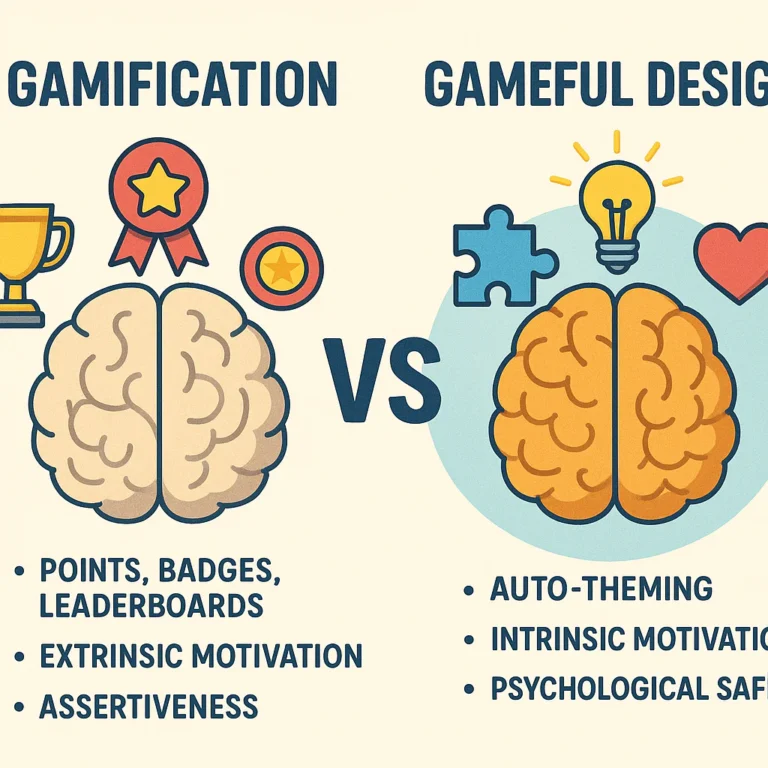
Game mechanics shape attention and behaviour. They do not work like magic buttons. The same leaderboard that energizes one group can discourage another, and the same reminder that helps one person can feel intrusive to someone else.
The Octalysis Framework and research on gameful design offer ways to think about motivation, but any framework is a design aid—not proof that a feature will produce a mental-health outcome. Our Game Mechanics and Gamification and UX Design collections explore how these choices affect user experience.
Motivation, autonomy, and self-determination theory
Self-determination theory proposes that motivation is supported by autonomy, competence, and relatedness: a sense of choice, capability, and connection. The theory is widely applied in education and behaviour design; see Deci and Ryan’s overview.
| Need | Helpful design choice | Risky alternative |
|---|---|---|
| Autonomy | Offer several quests or ways to complete a task | Force one rigid path |
| Competence | Increase challenge gradually; explain feedback | Make failure mysterious or punitive |
| Relatedness | Invite optional peer support | Expose personal progress to the whole group |
A resilience activity should invite participation rather than coerce disclosure. Let users skip prompts, choose a private mode, or take a break without losing everything they have earned.
Progress, feedback, and self-efficacy
Feedback is most useful when it tells someone what they did and what they can try next. “You’re amazing!” may feel nice, but “You identified the thought that increased your stress and generated one alternative” is more actionable.
A good feedback loop looks like this:
- Set a small, clear challenge.
- Let the person choose an approach.
- Give specific feedback tied to the action.
- Offer another attempt or a slightly harder task.
- Invite reflection on whether the skill fits real life.
The eQuoo trials described features such as levels, progress maps, points, narrative, avatar customization, mini-games, and badges. These mechanics were part of a larger package that also included psychological skills and scenario-based learning. This is a more meaningful combination than scattering rewards over unrelated content. (PLOS ONE; JMIR Mental Health)
Social connection, competition, and belonging
Social design can help people feel less alone—but resilience is personal, and public comparison can be a poor fit.
- Prefer coperative goals over rank-based leaderboards when the target is well-being.
- Let people share progress voluntarily and selectively.
- Celebrate helpful behaviours, such as checking in on a teammate, not only output.
- Avoid public rankings based on mood, symptoms, or personal disclosures.
Competition may work for low-stakes fitness or classroom activities when participants opt in and the rules are fair. It is less appropriate when users are sharing vulnerability or when scores could affect employment, grades, or access to care.
📈 How Gamification Can Strengthen Resilience
Gamification can support resilience when it helps people practise a skill repeatedly, receive usable feedback, and apply the skill outside the activity. The goal is not to turn life into a game. It is to make practice approachable enough to repeat.
Coping skills and emotional regulation
A scenario can let a learner rehearse emotional regulation without having to disclose a personal experience. For example, a story character receives an upsetting message. The user can pause, identify the feeling, consider an interpretation, and choose a response.
A useful exercise might ask:
- What emotion could the character be experiencing?
- What assumption might be increasing the distress?
- What is one response that is safe and proportionate?
- Who could offer support?
The aim is not to teach people to suppress emotion. It is to help them recognize feelings and choose a response rather than being pushed around by the first impulse.
For clinical mental-health concerns, self-guided apps should be treated as support tools, not diagnosis or treatment by default. The NHS mental health and self-help resources provide information on seeking appropriate care.
Growth mindset and learning from setbacks
A well-designed game makes another attempt possible. A poorly designed game makes failure embarrassing.
Resilience-supportive feedback frames a setback as information:
- “This strategy didn’t fit the situation. Want to try another?”
- “You paused before responding. That’s a useful step, even if the conversation is still hard.”
- “You missed a day. Your progress is still here; choose a small restart.”
This is different from pretending every outcome is positive. A reflection activity can acknowledge real difficulty while helping a person identify choices, support, or learning.
Habit formation and sustained engagement
Small actions repeated over time can become easier to recall and perform. Game features can provide cues and structure, but frequency alone does not guarantee a habit or transfer.
A practical loop:
Cue → small action → meaningful feedback → reflection → next opportunity
Keep the action short enough to complete on a difficult day. Avoid daily requirements that make missing one session feel like total failure.
| Habit-design question | Resilience-friendly answer |
|---|---|
| How often should people practise? | Frequently enough to build familiarity, but with flexible pacing |
| What happens after a missed session? | Offer a straightforward restart without penalty |
| What counts as progress? | Skill use and thoughtful practice, not only attendance |
| How should reminders work? | Opt-in, adjustable, and easy to pause |
| When is a streak useful? | When it motivates gently and never erases progress after a break |
⚖️ Potential Benefits and Risks of Gamified Resilience Programs
Gamification may lower the friction of practice. It can also add pressure, competition, or distracting rewards. Strong design considers both sides before launch, not after users start complaining.
Benefits for mental well-being and stress management
Potential benefits include:
- Engaging practice: A story or quest may make psychological education easier to approach.
- Visible progress: Users can see that they have completed practice, even if personal growth is gradual.
- Low-stakes rehearsal: Scenarios offer a chance to think through choices before acting in real life.
- Flexible delivery: Mobile activities may fit into a wider support program.
- Better retention: The eQuoo trials found notably higher study completion than comparison conditions, though app content and structure differed. (PLOS ONE; JMIR Mental Health)
The first video embedded in this article presents a similar access-focused perspective: it describes eQuoo as a way to make psychoeducation engaging for younger and casual-gamer audiences, with instant feedback and pathways to further support. That is a useful design ambition, but a video’s description of a product should not be mistaken for independent evidence of efficacy. The clinical-trial findings and their limitations are better guides to what has been tested.
Risks: pressure, comparison, and reward dependence
Potential drawbacks include:
- Leaderboard anxiety: Ranking can turn a private skill-building activity into a public contest.
- Streak pressure: A missed day can feel like failure, even when rest is appropriate.
- Reward substitution: Users may chase points rather than practise the intended skill.
- Privacy concerns: Mood, behaviour, and personal reflections are sensitive information.
- Overclaiming: “Build resilience” may sound like a guaranteed result if claims are not carefully qualified.
- Accessibility gaps: Timed challenges, flashing effects, or small text can exclude users.
The US Federal Trade Commission’s guidance on health products is a reminder that health-related claims need appropriate substantiation. Designers and organizations should also consider privacy requirements relevant to their users and jurisdiction.
Who may benefit—and who may need a different approach
Gamified practice may suit people who enjoy interactive learning, want a low-stakes way to rehearse skills, or need a structured prompt to return to an activity. It may be less suitable for someone who finds games stressful, is experiencing acute distress, or needs direct clinical assessment.
| Situation | Sensible approach |
|---|---|
| Classroom prevention program | Offer a noncompetitive option and keep sensitive reflections private |
| Workplace well-being initiative | Keep participation voluntary; do not expose individual data to managers |
| Mild stress or skills practice | Use short activities alongside reliable self-help information |
| Severe distress or safety concern | Prioritize appropriate professional or emergency support |
| User dislikes game elements | Provide a plain, nongamified route to the same content |
Choice is a safety feature. A resilient program lets people take a different route.
🏫 Where Gamification Supports Psychological Resilience
The best mechanics depend on the setting. Students may benefit from cooperative challenges. An employee program needs privacy safeguards. A clinical support tool needs clear escalation routes and careful claims.
Schools and higher education
In education, gamified resilience activities can help learners practise emotional vocabulary, problem-solving, reflection, and help-seking. They should complement teaching and pastoral support, not replace them.
Good practices include:
- Use fictional scenarios when discussing sensitive experiences.
- Make peer sharing optional.
- Reward effort and collaboration rather than disclosure.
- Include clear referral routes to a trusted adult or student support service.
- Avoid grading students on emotional responses.
Explore our Educational Gamification and Game-Based Learning resources for classroom design examples. The five-week eQuoo university trial provides a relevant digital-health example, but it should not be taken as proof that every student-facing game will produce the same results. (Study details)
Workplaces and employee well-being
Workplace programs need a clear boundary between support and performance management. Employees should not have to reveal mental-health information to earn rewards or satisfy a manager.
A sensible workplace design:
- Make participation voluntary.
- Keep individual well-being data confidential.
- Report group-level results only when privacy is protected.
- Avoid competitions that reward attendance or activity volume alone.
- Offer routes to employee assistance or professional support.
The Bosch UK employee trial of eQuoo offers one example of a workplace sample, but the researchers noted limitations in generalizing beyond that group and in attributing effects to gamification alone. (PLOS ONE)
Healthcare, therapy, and digital mental health
In health contexts, gamified tools can support psychoeducation, practice, or homework when they fit the care plan. The tool should explain what it can and cannot do, protect sensitive data, and direct users to professional help when needed.
Useful design questions:
- Is the content evidence-informed and reviewed by qualified professionals?
- Are the limits of the app clearly stated?
- Can users reach a person or service if their needs exceed the tool?
- Is data collection proportionate and transparent?
- Is there an accessible non-game option?
The NHS App Library and NICE guidance on evidence standards for digital health technologies are useful starting points for thinking about trust and evaluation.
Fitness, physical education, and community programs
Movement-based challenges can combine physical activity, social connection, mastery, and recovery. Keep the focus on participation and personal progress rather than body comparison or public ranking.
One ResearchGate page is titled Gamified Physical Education Participation and Its Impact on Mental Well-Being Among Adolescents, but the supplied page does not provide accessible article content or verifiable findings. We therefore cannot responsibly cite it as evidence that gamified physical education improves resilience. (ResearchGate record)
For community programs, try cooperative missions such as “complete a shared movement goal” or “notice and celebrate one personal improvement.” Make seated, low-impact, and offline alternatives available.
🛠️ 10 Evidence-Informed Ways to Gamify Resilience Building
These practices are design recommendations—not a guarantee of clinical outcomes. The strongest approach is to connect each mechanic to a specific skill and test whether participants can use that skill beyond the game.
1. Set meaningful, achievable goals
Turn “be more resilient” into an action a person can actually try.
- Too broad: “Improve mental health.”
- More useful: “Practise one alternative response to a stressful thought.”
- More personal: “Choose one supportive person to contact when I feel overwhelmed.”
Make goals adjustable. People should be able to reduce the challenge without being treated as if they failed.
2. Break challenges into manageable levels
Progression works best when each step builds on a previous skill.
- Recognize a stress signal.
- Name the emotion.
- Pause and identify options.
- Choose a safe next action.
- Reflect on what helped.
Avoid turning a sensitive topic into a dramatic “boss battle.” Metaphors can be fun, but they should not trivialize real suffering.
3. Give timely, constructive feedback
Feedback should be immediate enough to help, but specific enough to teach.
✅ “You considered two possible explanations before replying.”
❌ “Wrong answer. Try again.”
Explain why a choice may help in a scenario. When there is no single right answer, say so. Real life is not a multiple-choice quiz with a hidden perfect response.
4. Reward effort, reflection, and recovery
Reward a person for practising the process, not for having a particular emotion or outcome.
Possible rewards:
- A badge for trying a new coping strategy.
- A progress marker for reflecting after a setback.
- A team milestone for helping each other.
- A “rest day” option that preserves continuity.
Do not reward users for reporting lower anxiety or appearing cheerful. That can encourage people to hide difficulties.
5. Offer choice and personal control
Give people meaningful options:
- Choose a quest.
- Pick a character or scenario.
- Select a private or social mode.
- Pause reminders.
- Use a plain-text alternative.
Choice supports autonomy and can reduce the sense that a well-being activity is another obligation imposed from above.
6. Build in safe opportunities to try again
A restart should be normal, not a punishment.
- Let users revisit a scenario.
- Explain that mistakes are part of practice.
- Keep progress after a missed session.
- Avoid penalties for stopping or taking a break.
The best “retry” mechanic is sometimes simply a calm invitation to continue when the person is ready.
7. Use stories and meaningful missions
Narrative can make an abstract skill concrete. A character dealing with a misunderstanding, for example, can model how to pause, check assumptions, and communicate.
Keep the story respectful:
- Avoid stereotypes about mental illness.
- Do not imply that every problem has a neat ending.
- Show help-seking as a competent action.
- Make the fictional scenario relatable without forcing personal disclosure.
eQuoo used an interactive narrative alongside psychological content, quizzes, and other mechanics. That combination is more instructive than treating story as decoration. (JMIR Mental Health)
8. Encourage supportive teamwork
Use cooperative goals to make connection part of the experience.
Examples:
- A class earns a shared milestone by completing optional coping-skill activities.
- A team practises giving specific, respectful encouragement.
- Participants share one strategy they found useful, without being required to reveal personal details.
Teamwork should never become surveillance. People need permission to participate quietly.
9. Track progress without shaming people
A progress map can show what a person has practised. It should not label them as lazy, weak, or behind.
Prefer:
- Personal progress over public ranking.
- Trends over single-day scores.
- User-controlled visibility.
- A clear explanation of what is being tracked.
Avoid turning mental-health data into employer dashboards or classroom grades. A participant’s private feelings are not a performance metric.
10. Make reflection part of the reward loop
Reflection is where a game action can connect to real life.
Ask short, optional questions:
- “What felt useful?”
- “Where might you try this?”
- “What could make this harder?”
- “Who could support you?”
Close the loop by helping users identify one next step. If the only takeaway is a badge, the game may have rewarded completion rather than learning.
🧩 Designing a Gamified Psychological Resilience Program
A strong program starts with a defined audience, a specific skill, and a plan for evaluating outcomes. Start with the human need; add the game layer afterward.
Define the audience, needs, and outcomes
Write a one-sentence purpose:
“This program helps [audience] practise [specific resilience-related skill] in [setting] through [activity].”
Then decide how you will know whether it is helping. Examples include:
- Participants can identify a coping option in a scenario.
- Participants report that the activity feels usable and safe.
- Participants return to practise without feeling pressured.
- Participants know where to seek additional support.
Do not claim that a program “prevents depression” or “treats anxiety” unless it has appropriate evidence and authorization for that claim.
Choose game mechanics that support resilience
| Target skill | Possible mechanic | Design caution |
|---|---|---|
| Flexible thinking | Branching story choices | Avoid one “correct” response when context matters |
| Help-seking | Optional connection quest | Protect privacy and avoid forced disclosure |
| Emotional awareness | Mood or emotion check-in | Don’t treat a check-in as diagnosis |
| Problem-solving | Multi-step mission | Make steps adjustable and accessible |
| Persistence | Levels with retries | Don’t penalize breaks |
| Social support | Cooperative objective | Prevent peer pressure or public ranking |
For deeper UX considerations, see our Gamification and UX Design category.
Balance intrinsic motivation and extrinsic rewards
Points and badges can provide an immediate signal of progress, but they should not replace the value of learning. Use rewards sparingly and tie them to behaviours that matter.
A good balance:
- Explain why the activity is useful.
- Offer choice and meaningful challenge.
- Give feedback that builds capability.
- Use rewards as a light progress cue.
- Let the experience remain worthwhile without prizes.
If users stop practising as soon as rewards disappear, the design may have overemphasized the reward loop.
Make the experience accessible, inclusive, and trauma-informed
Accessibility is not a decorative feature. It determines who can participate.
- Use plain language, captions, keyboard support, and readable contrast.
- Provide alternatives to audio, timed play, and motion-heavy effects.
- Avoid asking users to recount traumatic experiences as a condition of progress.
- Make opt-out, pause, and support options easy to find.
- Test with people from the intended audience, including those with disabilities.
- Explain what data is collected and why.
The W3C Web Content Accessibility Guidelines offer a practical baseline for digital accessibility.
📊 Measuring Gamification’s Impact on Resilience
A good evaluation asks more than, “Did people finish the game?” It checks whether the experience was usable, whether skills were learned, and whether those skills made a difference beyond the screen.
Resilience, well-being, and engagement measures
Choose measures that match the purpose. The eQuoo studies used different resilience instruments, including the Resilience Research Centre Adult Resilience Measure and the Ruged Resilience Measure, alongside other mental-health measures in the student trial. Results from different scales should not be casually compared as if they were identical.
Track multiple levels:
| Level | Example measure | What it tells you |
|---|---|---|
| Reach | Enrollment and eligible-user participation | Who the program reaches |
| Engagement | Sessions, completed activities, return rate | Whether people use it |
| Learning | Scenario responses or skill knowledge | Whether users understand the material |
| Skill use | Self-reported real-world practice | Whether learning transfers |
| Well-being | Appropriate validated measures | Whether outcomes change over time |
| Safety | Distress, complaints, referral use | Whether risks are being noticed |
If you use a validated measure, follow its scoring instructions and consider the population for which it was designed. The NIH PROMIS resources provide information about standardized health measures.
Study design, comparison groups, and follow-up
To test the effect of game mechanics specifically, researchers ideally compare the same content in a gamified and nongamified format. If the apps teach different skills, use different schedules, or provide different support, the study cannot cleanly attribute differences to gamification.
Stronger evaluations can include:
- A clearly defined target population.
- Random assignment when feasible.
- An active comparison condition with equivalent content.
- Measures collected at baseline, during use, and after the program.
- Follow-up to test whether benefits persist.
- Usage data that respects privacy.
- Reporting of attrition and missing data.
The eQuoo trials were encouraging, but the authors recommended more work to “shine light into the ‘black box’” of which specific features produce benefits. That is exactly the right research question.
Interpreting results and avoiding misleading metrics
A statistically significant result does not automatically mean an effect is large, lasting, or meaningful to every user. Look at effect sizes, uncertainty, comparison groups, attrition, and the measure used.
A quick evidence check:
- Was the sample large and relevant to the intended audience?
- Was there an appropriate comparison condition?
- Were the interventions similar apart from gamification?
- Were outcomes self-reported, behavioural, or both?
- Did participants complete follow-up?
- Was the program tested over enough time to assess durability?
- Were adverse effects or user concerns reported?
One useful warning: retention is valuable, but it is not a substitute for effectiveness. An engaging app that does not improve the target skill may keep people busy without helping them cope better.
🔬 What Research Says: Evidence, Limitations, and Open Questions
The evidence suggests gamified, skills-based mental-health tools can be promising, particularly for engagement and self-reported resilience. The evidence does not yet support sweeping claims that adding game mechanics will reliably improve resilience for everyone.
What studies suggest about gamification and mental health
eQuoo trial with Bosch UK employees
In a five-week randomized trial, eQuoo was compared with CBT Thought Diary and a waitlist. The trial analyzed 358 participants who completed the final assessment. The study reported a modest increase in eQuoo participants’ resilience scores and significantly higher retention than the comparison groups. However, the active apps had different content and purposes, and usage time and module completion were not tracked. (PLOS ONE)
eQuoo trial with UK university students
A later five-week randomized trial recruited 1,165 students across 180 UK universities and compared eQuoo with Sanvello and a waitlist. The researchers reported improved resilience scores in the eQuoo group and higher endpoint questionnaire completion than in the comparison conditions. They also noted that the differences between eQuoo and Sanvello might not be caused solely by gamification. The trial relied on self-report and lacked long-term follow-up. (JMIR Mental Health)
A fair reading of the results
| Finding | Why it is encouraging | Why caution still matters |
|---|---|---|
| Resilience scores improved in eQuoo conditions | The intervention was designed around psychological skills, not rewards alone | Different measures and samples limit direct comparison |
| Retention was higher in the eQuoo groups | Engagement is a real challenge for digital tools | Retention does not prove skill transfer or lasting benefit |
| Some well-being measures also improved | The app may support more than one outcome | Comparison apps and study designs differed |
| Trials used randomized designs | Randomization strengthens causal inference | It cannot isolate game mechanics when content differs |
Research gaps and limits to the evidence
Researchers still need to determine:
- Which mechanics matter most: narrative, feedback, rewards, personalization, or social play?
- Do gains last beyond a short intervention?
- Do people use the taught skills during real stress?
- How do results vary by age, culture, disability, gaming familiarity, or clinical need?
- When do rewards help, and when do they undermine autonomy?
- How can privacy and safety be protected in schools and workplaces?
The ResearchGate record for Gamified Physical Education Participation and Its Impact on Mental Well-Being Among Adolescents is not accessible enough to verify its methods or findings from the supplied page. We therefore do not use it to support claims about resilience or adolescent mental well-being. (ResearchGate record)
🚫 Common Gamification Mistakes to Avoid
| Mistake | Why it causes trouble | Better design |
|---|---|---|
| Adding points before defining the skill | Rewards may distract from the purpose | Identify the target behaviour first |
| Treating resilience as “never quit” | It can encourage overwork or silence | Include rest, adaptation, and help-seking |
| Making a leaderboard mandatory | Public ranking can embarrass or exclude | Offer private progress and optional teamwork |
| Punishing missed days | Life disruptions become “failure” | Let people restart without losing progress |
| Overloading users with notifications | Prompts can add stress | Make reminders adjustable and opt-in |
| Confusing engagement with impact | Clicks do not prove learning | Measure skills and outcomes separately |
| Asking for sensitive disclosures | Users may feel exposed or unsafe | Use fictional scenarios and optional reflection |
| Overpromising clinical benefit | Can mislead people who need care | State evidence, limits, and support routes clearly |
| Using one-size-fits-all mechanics | People differ in access, preference, and needs | Offer alternatives and test with users |
A quick design test: Would this mechanic still feel respectful if a participant were having a difficult week? If the answer is no, redesign it.
❓ Frequently Asked Questions
How does gamification affect psychological resilience?
Gamification may support resilience by making skill practice more engaging, structured, and repeatable. Activities can help users practise flexible thinking, emotional awareness, problem-solving, and help-seking.
The effect depends on the quality of the underlying content and whether people use the skills outside the game. Trials of eQuoo reported improved self-reported resilience, but because the apps differed in content as well as game mechanics, the studies cannot show that gamification alone caused the changes. (PLOS ONE; JMIR Mental Health)
Can gamified activities help people cope with stress and setbacks?
They can provide low-stakes rehearsal. A branching story might let someone practise pausing, checking an assumption, and choosing a response before facing a similar situation in real life.
That practice is not a guarantee of coping success. Stressors differ, and some require practical, social, or professional support beyond an app. A useful activity should include ways to ask for help, change strategies, and step away.
Which game mechanics can strengthen resilience and perseverance?
Mechanics that support choice, achievable challenge, constructive feedback, retries, reflection, and supportive connection are good candidates. Progress maps can make practice visible; narrative can give skills context; cooperative goals can build belonging.
Mechanics should fit the skill. A competitive leaderboard may motivate some users to complete a physical activity, but it is usually a poor fit for private emotional disclosures.
Does gamification improve emotional regulation and mental well-being?
It may help users learn and practise emotional-regulation strategies, but evidence varies by program and outcome. In the eQuoo student trial, the researchers reported improvements in resilience, anxiety, and depression scores compared with some study conditions. They also cautioned that differences between eQuoo and Sanvello could not be attributed to gamification alone. (JMIR Mental Health)
Treat a gamified tool as a possible support for well-being—not a diagnosis, treatment guarantee, or substitute for professional care when needed.
How can gamification build resilience in students and employees?
Use short, relevant activities that teach a specific skill. For students, that could mean practising problem-solving through fictional scenarios. For employees, it could mean learning how to pause, prioritize, or seek support during a demanding situation.
Keep participation voluntary, protect personal data, and avoid grading or managing people based on mental-health scores. In both settings, clear support pathways matter more than flashy rewards.
Can progress tracking and rewards encourage people to overcome challenges?
Yes, when they make effort and learning visible without creating shame. A progress map can show practice over time; a small reward can acknowledge a meaningful action.
Use personal progress rather than public comparison, and avoid rewards tied to emotional outcomes such as “feling happy.” People should retain progress after taking a break. The reward should point back to the skill, not replace it.
What are the risks of using gamification to promote psychological resilience?
Risks include pressure from streaks, unhealthy comparison, privacy problems, inaccessible mechanics, reward dependence, and exaggerated claims about mental-health benefits. People may also feel that distress is being gamified instead of taken seriously.
Mitigate these risks by offering choice, private progress, easy pauses, plain-language explanations, accessible alternatives, and referral information. Do not use a game as the sole response to severe distress or a safety concern.
How should you evaluate whether a resilience game is actually helping?
Measure more than participation. Track whether people understand the intended skills, whether they practise them outside the activity, how safe and usable the experience feels, and whether relevant outcomes change over time.
Where possible, compare equivalent content with and without game mechanics. Report attrition, limitations, and adverse experiences. A high completion rate is encouraging—but it is only one part of the answer.
Is a gamified resilience app a substitute for therapy?
No. A self-guided app may offer psychoeducation or practice, but it should not be assumed to provide assessment or treatment. People experiencing serious or persistent distress should seek appropriate support through a qualified professional or local health service. The NHS mental health resources provide information for people in the UK.
✅ Practical Takeaways for Educators, Employers, and Designers
- Begin with a resilience skill, not a points system.
- Make the action small enough to try on a difficult day.
- Use feedback that explains what worked and what to try next.
- Offer choice, privacy, accessible alternatives, and an easy pause.
- Reward effort, reflection, connection, and recovery—not emotional performance.
- Measure learning and real-world skill use alongside engagement.
- Be honest about the evidence: promising findings are not proof that game mechanics alone caused the effect.
- Build in routes to human support when a game is not enough.
Our recommendation is confident but measured: use gamification as a thoughtful practice layer around useful, evidence-informed resilience skills—not as a substitute for care or a shortcut to well-being. The strongest design is not the one with the most badges. It is the one people can use, adapt, and carry with them when the screen is off.