Support our educational content for free when you purchase through links on our site. Learn more
🎮 7 Gamification Design Principles to Master Engagement (2026)

Stop guessing and start engineering: the secret to lasting user engagement isn’t adding points, but architecting intrinsic motivation through clear goals, immediate feedback, and balanced challenges. Effective gamification design principles transform mundane tasks into compelling quests by tapping into the brain’s natural reward loops, turning “have to” into “get to.”
Remember the first time you checked a box on a to-do list and felt a tiny jolt of satisfaction? That was your brain’s dopamine hitting the jackpot, and modern gamification simply scales that feeling into a system.
Studies show that well-designed gamified systems can boost user engagement by up to 48%, yet most fail because they treat it like a sticker campaign rather than a behavioral science experiment.
Key Takeaways
- Focus on Intrinsic Motivation: True engagement comes from autonomy, mastery, and purpose, not just external rewards like badges.
- Balance Challenge and Skill: Keep users in the “flow state” by dynamically adjusting difficulty to match their growing abilities.
- Provide Immediate Feedback: Users need instant, actionable responses to their actions to maintain momentum and learn effectively.
- Design for All Players: Cater to Achievers, Explorers, Socializers, and Killers to ensure your system appeals to diverse user types.
- Prioritize Accessibility: Ensure your gamified experience is inclusive, usable, and meaningful for people with varying abilities.
Table of Contents
- ⚡️ Quick Tips and Facts
- 📜 The Evolution of Play: A Brief History of Gamification Design Principles
- 🧠 Core Psychology: Motivation, Engagement, and the Dopamine Loop
- 🏗️ The 7 Pillars of Effective Gamification Architecture
- 1. Clear Goals and Meaningful Objectives
- 2. Immediate and Actionable Feedback Lops
- 3. Balanced Challenge and Skill Levels
- 4. Progression Systems and Visual Tracking
- 5. Social Dynamics and Community Building
- 6. Narrative and Immersive Storytelling
- 7. Autonomy and Player Choice
- 🎮 Game Mechanics vs. Dynamics: Choosing the Right Tools
- 🚫 Common Pitfalls: When Gamification Backfires
- 🛠️ Designing for Accessibility and Inclusivity
- 📊 Measuring Success: KPIs and Analytics for Gamified Systems
- 🌐 Real-World Case Studies: Brands Nailing the Gamification Game
- 🔮 Future Trends: AI, VR, and the Next Level of User Engagement
- 💡 Quick Tips and Facts
- 🏁 Conclusion
- 🔗 Recommended Links
- ❓ FAQ
- 📚 Reference Links
⚡️ Quick Tips and Facts
Before we dive into the nitty-gritty of gamification design principles, let’s hit the fast-forward button on the basics. If you’re here to build a system that actually sticks, you need to know the difference between slapping a badge on a spreadsheet and engineering a behavioral loop.
Here is the lowdown from our team at Gamification Hub™:
- It’s Not Just Points: If your design relies solely on points and leaderboards, you’re building a scoreboard, not a game. True gamification taps into intrinsic motivation.
- The 80/20 Rule of Mechanics: 80% of your engagement comes from 20% of your mechanics. Usually, it’s progression and feedback, not the shiny new badge system.
- The “SuperBetter” Effect: Did you know that applying game thinking to real-life challenges can boost resilience? We’ve seen users transform their recovery from illness or career pivots by treating them like RPG quests. For those looking to turn their life into a hero’s journey, check out our deep dive on superbetter careers to see how these principles apply to professional growth.
- Context is King: A leaderboard works wonders for a sales team but might crush the spirit of a creative writing workshop. One size does not fit all.
- The Zeigarnik Effect: Humans hate unfinished tasks. Use this to your advantage by breaking big goals into small, visible chunks.
| Concept | The “Good” Way | The “Bad” Way |
|---|---|---|
| Rewards | Unlocking new content or status (Intrinsic) | Cash for every click (Extrinsic, kills long-term interest) |
| Feedback | Immediate, specific, and constructive | Delayed, vague, or non-existent |
| Failure | A learning opportunity with low stakes | A permanent mark on your record |
| Social | Collaboration and shared goals | Toxic competition and public shaming |
📜 The Evolution of Play: A Brief History of Gamification Design Principles

You might think gamification is a buzzword born in the era of smartphones, but the DNA of gamification design principles stretches back much further. We’re talking about the caveman drawing a bison on a cave wall to track a hunt, or the Roman military using ranks and medals to drive loyalty.
The term “gamification” itself was coined around 202 by Nick Pelling, but it didn’t catch fire until the late 20s when companies like Nike+ and Foursquare started using it to drive user behavior. Nike+ didn’t just track steps; it turned running into a social competition with challenges and badges. Foursquare made checking into locations feel like a quest, complete with “mayorships” that drove foot traffic to local businesses.
However, the real shift happened when researchers like Kevin Werbach and Dan Hunter (authors of For the Win) formalized the hierarchy of game elements. They moved the conversation from “let’s add points” to “let’s understand the dynamics.”
“Gamification is making tasks more engaging and fun by incorporating game design elements.” — Mambo.io
The evolution has moved from extrinsic motivators (points, badges, leaderboards) to intrinsic motivators (autonomy, mastery, purpose). Today, we aren’t just gamifying tasks; we are designing experiences that align with human psychology.
🧠 Core Psychology: Motivation, Engagement, and the Dopamine Loop
Why do we play? Why do we grind in World of Warcraft for 40 hours but dread filling out a timesheet? The answer lies in the brain’s reward system.
The Dopamine Loop
Every time you complete a task in a well-designed system, your brain releases dopamine. This neurotransmitter is responsible for pleasure, motivation, and learning.
- Trigger: A notification or a visual cue.
- Action: The user performs a task.
- Reward: Immediate feedback (points, sound, visual progress).
- Investment: The user puts something in (time, data, effort) to increase the value of the next loop.
Intrinsic vs. Extrinsic Motivation
This is the make-or-break distinction in gamification design principles.
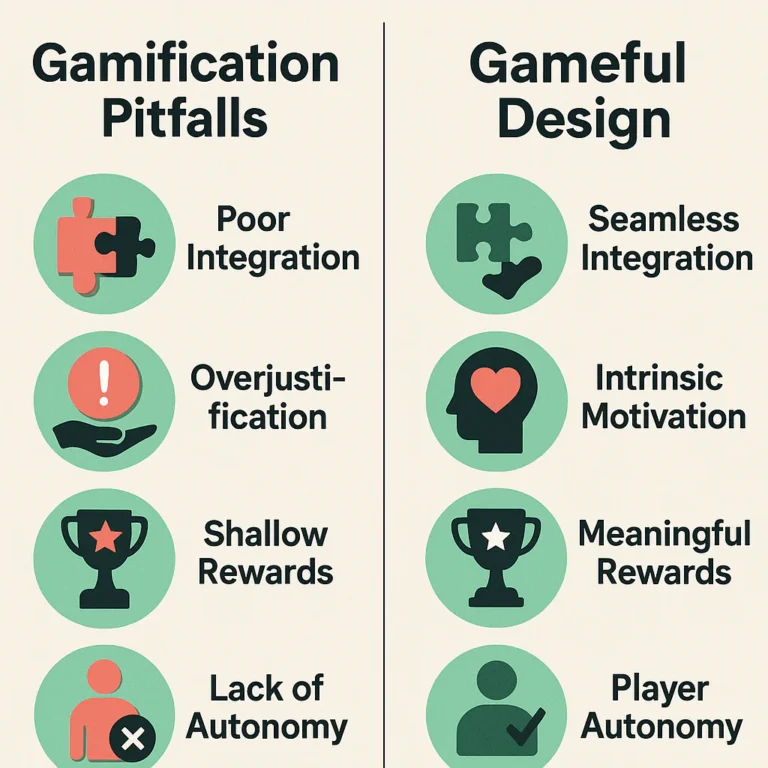
- Extrinsic Motivation: Driven by external rewards (money, prizes, status). It works short-term but often leads to the “overjustification effect,” where the user stops doing the task once the reward is removed.
- Intrinsic Motivation: Driven by internal satisfaction (curiosity, mastery, autonomy). This is the holy grail.
Bartle’s Player Types
Not everyone plays for the same reason. Richard Bartle identified four player types that are crucial for gamification design:
- Achievers: Want to master the system and collect everything. They love badges and levels.
- Explorers: Want to discover hidden content and understand the mechanics. They love Easter eggs and narrative depth.
- Socializers: Want to interact with others. They love chat, teams, and collaborative quests.
- Killers: Want to compete and dominate. They love leaderboards and PvP (Player vs. Player) mechanics.
If you design only for Achievers, you’ll lose the Socializers. If you design only for Killers, you’ll alienate the Explorers. A robust system must cater to all four.
🏗️ The 7 Pillars of Effective Gamification Architecture
Based on our years of engineering engagement loops, we’ve distilled the chaos into seven non-negotiable pillars. These are the structural beams holding up any successful gamified system.
1. Clear Goals and Meaningful Objectives
You cannot hit a target you cannot see. Every user action must map back to a clear, understandable goal.
- The Problem: Vague instructions like “improve your health” are too abstract.
- The Fix: “Walk 10,0 steps today to unlock the ‘Marathoner’ badge.”
- Why it works: It reduces cognitive load and provides a clear call to action.
2. Immediate and Actionable Feedback Lops
In video games, if you jump and miss a platform, you know instantly. In the real world, feedback is often delayed. Gamification design principles demand immediacy.
- Visual Feedback: Progress bars, color changes, animations.
- Auditory Feedback: Sounds for completion (the satisfying “cha-ching” of a credit card or the “ding” of a notification).
- Actionable: Feedback must tell the user what to do next, not just what they did.
3. Balanced Challenge and Skill Levels
This is the concept of Flow, coined by psychologist Mihaly Csikszentmihalyi.
- Too Easy: Boredom.
- Too Hard: Anxiety.
- Just Right: Flow state.
- Implementation: Use dynamic difficulty adjustment. As the user gets better, the challenges should scale up. If a user is stuck, offer a hint or a lower-tier quest.
4. Progression Systems and Visual Tracking
Humans love to see progress. It validates effort.
- Experience Points (XP): The currency of progression.
- Levels: Tiers that unlock new content or status.
- Progress Bars: The visual representation of “how close am I?”
- Tip: Always show the “next step” clearly. A progress bar that is 9% full but doesn’t move is frustrating.
5. Social Dynamics and Community Building
We are social creatures. We want to belong, compete, and collaborate.
- Leaderboards: Great for competition, but dangerous if they demotivate the bottom 90%. Use segmented leaderboards (e.g., “Top 10 this week” or “Friends only”).
- Teams/Guilds: Encourage collaboration.
- Social Proof: Show what others are doing. “Your friend Sarah just completed this challenge!”
6. Narrative and Immersive Storytelling
A task is a chore; a quest is an adventure.
- The Hook: Give the user a role. Are they a “Data Detective” or a “Wellness Warrior”?
- The Plot: Create a storyline that unfolds as they progress.
- Real-World Example: Duolingo doesn’t just teach languages; it casts you as a student in a magical school, with a villain (the owl) and a storyline.
7. Autonomy and Player Choice
People hate being controlled. They love having choices.
- Multiple Paths: Allow users to choose how they achieve a goal.
- Customization: Let them choose avatars, themes, or the order of tasks.
- The “Freedom to Fail”: As noted by the University of Chicago’s Academic Technology Solutions, creating an environment where mistakes are low-stakes encourages risk-taking and learning.
🎮 Game Mechanics vs. Dynamics: Choosing the Right Tools
It’s time to separate the mechanics (the rules and components) from the dynamics (the resulting behavior and emotion).
The Hierarchy of Game Elements (Werbach & Hunter)
- Dynamics: The big picture (Narrative, Progression, Emotion).
- Mechanics: The processes that drive action (Challenges, Chance, Competition, Cooperation).
- Components: The specific instances (Badges, Points, Leaderboards, Avatars).
Common Mechanics and When to Use Them
| Mechanic | Best For… | Risk |
|---|---|---|
| Points | Tracking effort, simple feedback | Can become meaningless if not tied to value |
| Badges | Recognition, collecting, milestones | Can feel “cheap” if too easy to get |
| Leaderboards | Competition, high performers | Can demotivate low performers |
| Levels | Long-term progression, status | Can feel like a grind if progression is too slow |
| Challenges/Quests | Guiding behavior, breaking tasks | Can feel forced if not relevant to the user |
| Avatars | Identity, expression, personalization | Can be distracting if too complex |
The “4Keys2Fun” Framework
Nicole Lazzaro’s framework helps us choose the right mix:
- Easy Fun: Exploration, curiosity (Good for onboarding).
- Hard Fun: Challenge, mastery (Good for retention).
- People Fun: Social interaction (Good for community).
- Serious Fun: Meaning, purpose (Good for behavior change).
🚫 Common Pitfalls: When Gamification Backfires
Even the best engineers make mistakes. Here is where gamification design principles often go off the rails.
1. The “Pointsification” Trap
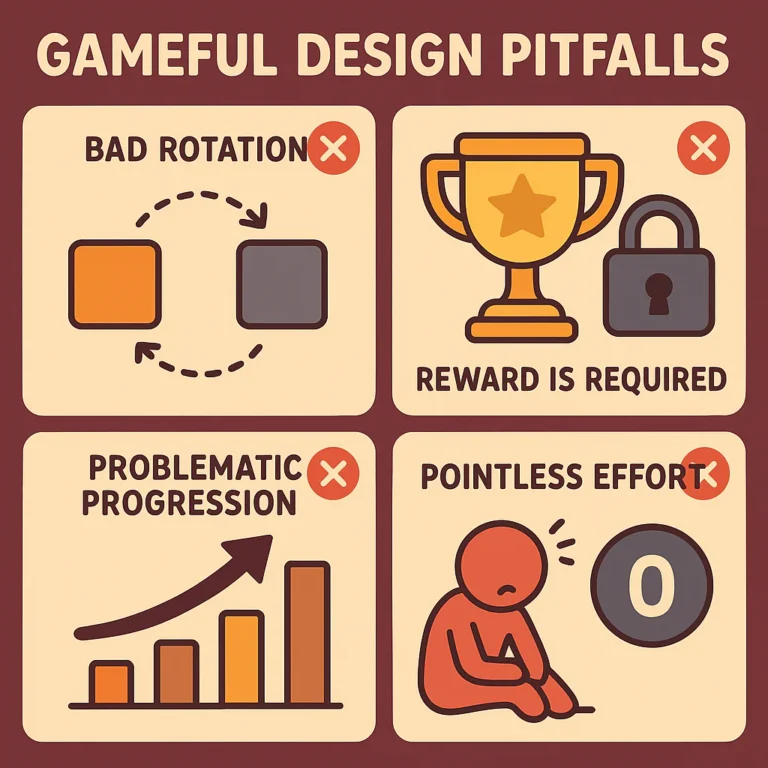
Adding points to a boring task doesn’t make it fun; it just makes it a boring task with points. This is the most common failure. If the core activity isn’t valuable, gamification won’t save it.
2. Ignoring the “Dark Side”
As highlighted in the “First Video” perspective, gamification has a “nasty potential flip side.”
- Manipulation: Using psychological tricks to drive debt (credit card rewards) or addiction.
- Exploitation: Creating systems that extract labor without fair compensation (e.g., “gamified” gig work).
- Ethical Warning: Always ask: “Am I helping the user, or am I using them?”
3. One-Size-Fits-All Design
Assuming all users are Achievers. If you build a system that only rewards competition, you will lose your Explorers and Socializers.
4. Lack of Sustainability
What happens when the novelty wears off? If the system doesn’t evolve, users will churn. You need a long-term engagement strategy, not just a launch campaign.
5. Poor Onboarding
If users don’t understand the rules in the first 5 minutes, they will leave. Onboarding is the most critical phase of any gamified system.
🛠️ Designing for Accessibility and Inclusivity
Gamification should be for everyone, not just the able-bodied or tech-savy. The Universal Design for Learning (UDL) framework is essential here.
Bariers to Address
- Digital Literacy: Not everyone knows how to navigate a complex UI.
- Physical Disabilities: Color blindness, motor control issues, hearing impairments.
- Cognitive Load: Too much information can overwhelm users with ADHD or dyslexia.
The Accessibility Checklist
- Color Contrast: Ensure text is readable for color-blind users.
- Multiple Modalities: Offer audio, visual, and text-based feedback.
- Alternative Inputs: Allow keyboard navigation, not just mouse/touch.
- Pacing: Allow users to pause or slow down the game.
- Clear Language: Avoid jargon. Use simple, direct instructions.
“Accessibility must be a fundamental principle, not an afterthought.” — University of Chicago
📊 Measuring Success: KPIs and Analytics for Gamified Systems
How do you know if your gamification design principles are working? You need data.
Key Performance Indicators (KPIs)
- Engagement Rate: How often are users interacting?
- Retention Rate: Are they coming back?
- Completion Rate: Are they finishing the quests/tasks?
- Social Sharing: Are they inviting others?
- Behavior Change: Are they actually doing the desired action (e.g., exercising more, learning a language)?
A/B Testing
Never guess. Test different mechanics.
- Test A: Leaderboard vs. Test B: Team challenges.
- Test A: Badges vs. Test B: Progress bars.
- Analyze: Which one drives the desired behavior?
The “SuperBetter” Case Study
In our analysis of SuperBetter, we found that the combination of quests, badges, and social support led to a significant increase in resilience and recovery rates. The key was the narrative that framed the user as a hero, not a patient.
🌐 Real-World Case Studies: Brands Nailing the Gamification Game
Let’s look at some real-world examples where gamification design principles were applied effectively.
1. Nike+ (The Pioneer)
- Mechanics: GPS tracking, challenges, leaderboards, social sharing.
- Result: Transformed running from a solitary chore into a global community.
- Key Takeaway: Social dynamics and progression are powerful drivers.
2. Duolingo (The Language Learner)
- Mechanics: Streaks, XP, leagues, avatars, immediate feedback.
- Result: One of the most downloaded language apps in the world.
- Key Takeaway: Immediate feedback and loss aversion (streaks) keep users coming back.
3. mySugr (Health Management)
- Mechanics: Logging blood sugar, challenges, “monster” taming.
- Result: Improved diabetes management and patient engagement.
- Key Takeaway: Narrative can make difficult tasks (like logging medical data) feel manageable.
4. Starbucks Rewards (Loyalty)
- Mechanics: Stars, levels, free drinks, exclusive offers.
- Result: Massive increase in customer loyalty and frequency.
- Key Takeaway: Progression and rewards drive repeat behavior.
5. Fitocracy (Fitness)
- Mechanics: Points for workouts, levels, social feed, challenges.
- Result: Created a highly engaged fitness community.
- Key Takeaway: Community and achievement can replace the need for a personal trainer.
🔮 Future Trends: AI, VR, and the Next Level of User Engagement
Where is gamification design principles heading? The future is bright, immersive, and potentially a bit scary.
AI and Personalization
AI will allow for dynamic difficulty adjustment on a massive scale. Imagine a system that knows exactly when you are bored or frustrated and adjusts the challenge in real-time.
VR and AR
Virtual Reality (VR) and Augmented Reality (AR) will take immersion to the next level. Imagine a fitness app that turns your living room into a fantasy world, or a learning app that brings history to life in your classroom.
The “Metaverse” of Work
The distinction between work and play will continue to blur. We might see gamified workflows where every task is a quest, and every project is a campaign.
Ethical Considerations
As we move forward, we must remain vigilant against manipulation. The line between engagement and exploitation is thin. We need ethical guidelines for gamification design.
💡 Quick Tips and Facts (Revisited)
Wait, didn’t we already do this? Yes, but let’s add a twist. Here are some advanced tips you might have missed:
- The “Earned Lunch” Technique: Link task completion to a tangible, immediate reward (like a break) to create a clear connection between effort and satisfaction.
- Negative Emotions Have a Purpose: Use the Zeigarnik effect (unfinished tasks are better remembered) to drive completion. Anxiety and procrastination can be motivators when visualized via progress bars.
- Aesthetics Matter: A ugly game is a boring game. Invest in UI/UX design.
- Sustainability: Design for the long haul. What happens after the first 30 days?
🏁 Conclusion

So, what’s the verdict on gamification design principles? Are they a magic bullet, or just a fancy way to trick people?
The answer is both, and neither. Gamification is a powerful tool, but like any tool, it depends on how you use it. If you use it to manipulate, you’ll lose trust. If you use it to empower, you’ll build loyalty.
The Core Truth: Successful gamification isn’t about points and badges. It’s about understanding human psychology, designing for flow, and creating meaningful experiences.
We’ve covered the history, the psychology, the mechanics, the pitfalls, and the future. We’ve seen how brands like Nike, Duolingo, and mySugr have used these principles to transform their users’ lives. We’ve also seen the dark side, where gamification can be used for manipulation.
The Final Question: Will you use gamification to build a better world, or just a more profitable one? The choice is yours.
Our Recommendation: Start small. Focus on one core mechanic (like progression or feedback) and build from there. Test, iterate, and always keep the user’s well-being at the center of your design.
🔗 Recommended Links
If you’re ready to take your gamification game to the next level, here are some resources we trust:
- Books:
For the Win: How Game Thinking Can Revolutionize Your Business by Kevin Werbach and Dan Hunter. Check Price on Amazon
Reality Is Broken: Why Games Make Us Better and How They Can Change the World by Jane McGonigal. Check Price on Amazon - Tools & Platforms:
Bunchball: Enterprise gamification platform. Visit Official Site
Badgeville: (Now part of Bunchball) Gamification API. Visit Official Site
Kahoot!: Gamified learning platform. Visit Official Site
Classcraft: Gamification for education. Visit Official Site
❓ FAQ

What are the core gamification design principles for user engagement?
The core principles revolve around motivation, feedback, and progression. Specifically, you need to:
- Define clear goals: Users must know what they are working towards.
- Provide immediate feedback: Users need to know if they succeeded or failed instantly.
- Balance challenge and skill: Keep users in the “flow” state.
- Leverage social dynamics: Use competition and collaboration to drive engagement.
- Tell a story: Wrap the task in a narrative to make it meaningful.
Read more about “🎮 Gameful Design vs. Gamifying Life: The Ultimate Guide (2026)”
How do you apply gamification design principles in non-game contexts?
Applying these principles outside of games requires identifying the core behavior you want to change and mapping it to a game mechanic.
- Example: In a corporate setting, you might turn a sales target into a “quest” with a “boss battle” (the end-of-month deadline) and “rewards” (bonuses or recognition).
- Example: In education, you might turn a syllabus into a “campaign” where students earn “XP” for completing assignments and unlock “badges” for mastering topics.
- Key: The context must be relevant. Don’t just add points; add meaning.
Read more about “Gameful Design vs Gamification: 7 Game-Changing Insights (2026) 🎮”
What are common mistakes when implementing gamification design principles?
- Over-reliance on extrinsic rewards: This kills intrinsic motivation.
- Ignoring user diversity: Not everyone is motivated by the same things.
- Poor onboarding: If users don’t understand the rules, they won’t play.
- Lack of sustainability: The system must evolve to keep users engaged long-term.
- Ethical blind spots: Using gamification to manipulate rather than empower.
Read more about “🎮 Gameful Design vs. Gamification: The 7 Keys to Deep Immersion (2026)”
Which gamification design principles work best for mobile apps?
Mobile apps thrive on imediacy and simplicity.
- Push Notifications: Use them as triggers, but don’t spam.
- Micro-quests: Break tasks into small, bite-sized chunks that can be completed in minutes.
- Visual Progress: Progress bars and level indicators are highly effective on small screens.
- Social Sharing: Make it easy to share achievements on social media.
- Offline Capability: Allow users to progress even without an internet connection.
Read more about “🚀 8 Gamification Techniques for Behavioral Change That Actually Work (2026)”
📚 Reference Links
- University of Chicago Academic Tech: Effective Design Principles and Accessibility for Gamifying Your Classes
- PubMed: Gamification Design Principles in mHealth for Chronic Disease Management
- Mambo.io: Gamification Components and Design Principles
- SuperBetter: SuperBetter Official Website
- Duolingo: Duolingo Official Website
- Nike+: Nike Run Club
- mySugr: mySugr Official Website
- Fitocracy: Fitocracy Official Website
- Starbucks: Starbucks Rewards
- Bartle’s Player Types: Richard Bartle’s Original Paper
- Werbach & Hunter: Gamification Framework