Support our educational content for free when you purchase through links on our site. Learn more
🚫 7 Deadly Gamification Pitfalls Gameful Design Fixes (2026)

Ever tried to motivate a team with a shiny new leaderboard, only to watch morale plummet instead of soar? You’re not alone. In fact, a staggering 80% of gamified projects fail to meet their objectives, often because they mistake “points and badges” for genuine engagement. At Gamification Hub™, we’ve seen it all: from corporate training modules that feel like digital chores to educational apps that drive students away with confusing rules. The culprit? A fundamental misunderstanding of human psychology and a reliance on superficial mechanics that quickly turn into “exploitationware.”
But there is a better way. Enter gameful design, the sophisticated antidote to these common failures. Unlike traditional gamification, which often slaps a thin layer of game elements onto a boring task, gameful design reimagines the entire experience from the ground up, focusing on intrinsic motivation, meaningful progression, and player autonomy. In this deep dive, we’ll dissect the 7 deadly sins of bad gamification, reveal why your leaderboard might be demotivating your top performers, and show you exactly how to build systems that users actually want to engage with. By the end, you’ll know how to transform your next initiative from a fleeting novelty into a self-sustaining engine of engagement.
🗝️ Key Takeaways
- Avoid the “Pointsification” Trap: Simply adding points and badges without meaningful context leads to rapid user burnout and disengagement.
- Prioritize Intrinsic Motivation: Successful systems tap into autonomy, mastery, and purpose rather than relying solely on extrinsic rewards.
- Design for Diverse Player Types: One-size-fits-all leaderboards fail; use frameworks like Bartle’s Player Types to cater to Achievers, Socializers, Explorers, and more.
- Embrace Gameful Design: Shift from top-down “gamification” to bottom-up gameful design to create inherently engaging, human-centered experiences.
- Iterate with Feedback: Continuous testing and clear, actionable feedback loops are essential to prevent confusion and maintain the “flow” state.
Table of Contents
- ⚡️ Quick Tips and Facts
- 📜 From Skinner to Slack: A Brief History of Gamification Pitfalls
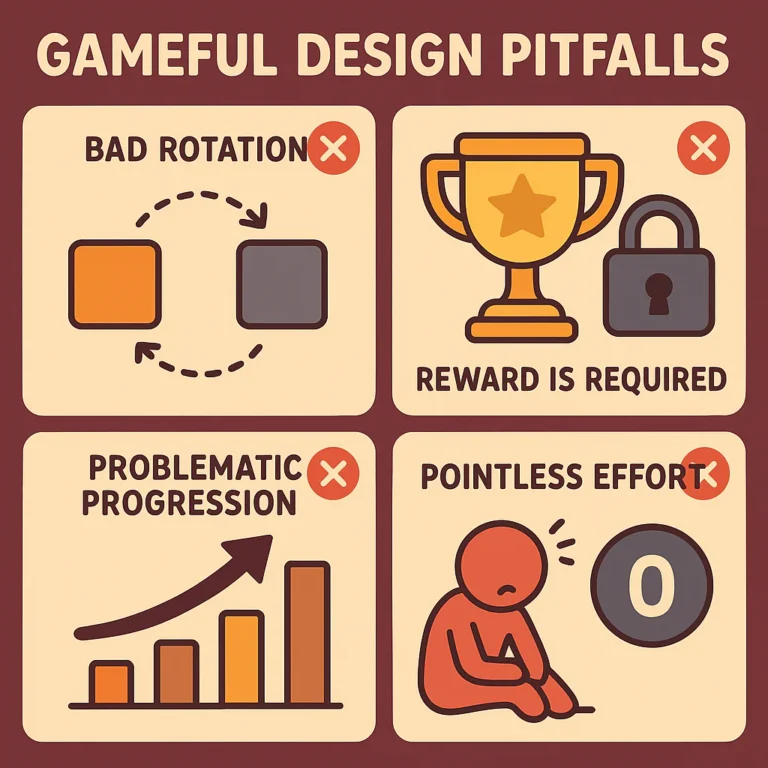
- 🚫 The Top 7 Deadly Sins of Bad Gamification Design
- 1. The “Pointsification” Trap: Why Badges Alone Don’t Work
- 2. Ignoring User Motivation: The Extrinsic vs. Intrinsic Clash
- 3. The Leaderboard Nightmare: Demotivating the Middle Pack
- 4. Lack of Meaningful Feedback Lops
- 5. Overcomplicating the Rules: Confusion Kills Engagement
- 6. Failing to Account for Player Types
- 7. Neglecting the Onboarding Experience
- 🛠️ Gameful Design: The Antidote to Common Gamification Failures
- 🧠 Understanding Player Psychologies: Bartle, Octalysis, and Beyond
- 🏗️ The Architecture of Engagement: Building Robust Game Mechanics
- 🎓 Educational Trends: Game-Based Learning vs. Gamified Learning
- 🏢 Avoiding Common Pitfalls of Gamification in the Workplace
- 📊 Case Studies: Brands That Nailed It (and Those That Flopped)
- 💡 Quick Tips and Facts for Immediate Implementation
- 🔮 Future Trends: AI, VR, and the Next Evolution of Gameful Design
- 🏁 Conclusion
- 🔗 Recommended Links
- ❓ FAQ
- 📚 Reference Links
Body
⚡️ Quick
Tips and Facts
Ever felt like you’re playing a game, even when you’re just, well, living life? That’s the magic (or sometimes, the mayhem!) of gamification. But here at Gamification Hub™, we’
ve seen it all – from brilliant successes that transform user engagement to spectacular failures that leave everyone scratching their heads. The truth is, while gamification holds immense promise, it’s a double-edged sword. A staggering 80% of gam
ified applications fail to meet their business objectives. Why such a high failure rate? Often, it boils down to misunderstanding the very essence of what makes games engaging.
That’s where gameful design
steps in, offering a more thoughtful, human-centered approach to integrating game elements into non-game contexts. It’s not just about slapping on points and badges; it’s about crafting experiences that resonate deeply with human psychology. Think of it as
the difference between a cheap plastic toy and a finely crafted wooden puzzle – both are “games,” but one offers a far richer, more enduring experience. Want to dive deeper into the nuances? Check out our article on Gameful Design vs. Gamification Examples.
📜 From Skinner to Slack: A Brief History of Gamification Pitfalls
Our journey into understanding gamification’s pitfalls really begins in the hallowed halls of behavioral psychology. Remember B.F. Skinner
and his operant conditioning? The idea that behavior could be shaped by rewards and punishments laid a foundational, albeit sometimes simplistic, groundwork for what would become gamification. Early attempts often mirrored this, focusing heavily on extrinsic motivators – think
gold stars, loyalty points, or even the classic “carrot on a stick.”
Fast forward to the early 2000s, and the digital revolution brought gamification into the mainstream. Companies like Foursquare, with its badges
and mayorships, showed us the potential for playful engagement in everyday activities. Yet, as the trend exploded, so did the misinterpretations. We saw a rush to “gamify everything,” often without a deep understanding of why games work
. Many early gamified systems, from corporate training modules to consumer apps, became little more than “pointsification” engines. They offered superficial rewards for mundane tasks, quickly leading to user fatigue and a feeling of being manipulated.
One of our engineers
, Alex, recalls a project from a decade ago: “We were tasked with gamifying a customer service portal. The initial brief was simple: ‘Add points for every ticket closed and a leaderboard!’ We pushed back, explaining that without a
sense of purpose or skill development, it would just feel like busywork. They went ahead anyway. Six months later, engagement plummeted, and agents felt more stressed than motivated. It was a classic case of ignoring the human element.” This anecdote
perfectly illustrates how a lack of gameful design principles can turn a promising idea into a demotivating chore.
🚫 The Top 7 Deadly Sins of Bad Gamification Design
We’ve seen countless gamification initiatives falter, not because the core idea was bad, but because the execution missed the mark. Here are the seven deadly
sins we’ve identified, and how gameful design offers a path to redemption.
1. The “Pointsification” Trap: Why Badges Alone Don’t Work
❌ The Issue: This is perhaps the most common pit
fall. You add points, badges, and maybe a progress bar to a task, thinking you’ve “gamified” it. But without a deeper connection to user goals or a sense of achievement, these elements quickly become meaningless. Users
earn points but don’t feel accomplished. It’s like collecting stickers without a sticker book – what’s the point? This over-reliance on non-educational rewards causes users to lose sight of the learning or task purpose, focusing solely
on the external reward rather than the subject matter.
✅ The Gameful Design Solution: Gameful design moves beyond superficial rewards to focus on meaningful progression and intrinsic motivation. Instead of just points, consider
how tasks contribute to a larger narrative or skill development. For instance, Duolingo doesn’t just give you points; it shows you your progress in learning a new language, unlocks new lessons, and celebrates your “streak” of consistent
effort. The reward is the tangible acquisition of a skill, not just a number on a screen. The positive effects of gamification occur more when teachers (or designers!) prioritize intrinsic motivation as they plan learning activities.
2. Ignoring User Motivation: The Extrinsic vs. Intrinsic Clash
❌ The Issue: Many gamified systems lean too heavily on extrinsic motivation – external rewards like discounts, virtual currency, or even public recognition. While these
can provide an initial boost, they often fail to sustain long-term engagement. Once the external reward is removed or loses its novelty, motivation plummets. This creates the “exact opposite of the desired outcome” when
users become motivated only by rewards and disinterested in the actual content.
✅ The Gameful Design Solution: The secret sauce of gameful design lies in tapping into intrinsic motivation – the desire to engage in an activity for its inherent
satisfaction. This means designing for autonomy, mastery, and purpose. Think about why people play video games for hours without external rewards. It’s the challenge, the sense of accomplishment, the freedom to explore, and the connection to a compelling
story. By focusing on these core human drives, gameful design creates self-sustained engagement. For more on the science behind this, explore our Behavior Science
category.
3. The Leaderboard Nightmare: Demotivating the Middle Pack
❌ The Issue: Leaderboards can be powerful motivators for a small segment of highly competitive users (often called “Achievers” – we’ll get to player types soon!). However, for the vast majority, leaderboards can be incredibly demotivating. If you’re consistently in the middle or at the bottom, seeing others constantly outperform you can lead to feelings of inadequacy, stress, and ultimately
, disengagement. It’s like being in a race where you know you’ll never win, so why even run?
✅ The Gameful Design Solution: Instead of a single, public leaderboard, gameful design advocates for **
personalized progress tracking, collaborative challenges, and smaller, more achievable goals**. Consider systems that allow users to compete against their past selves, or work together towards a common objective. For example, many fitness apps allow you to set personal bests and
celebrate your own milestones, rather than constantly comparing you to Olympic athletes. Or, in a corporate setting, team-based challenges can foster camaraderie rather than cutthroat competition.
4. Lack of Meaningful Feedback Loops
❌ The Issue:
Imagine playing a game where you perform an action, but nothing happens. No sound, no visual cue, no indication of success or failure. Frustrating, right? Many gamified systems suffer from a similar problem: they provide generic, unhelpful feedback
. A simple “Points Awarded!” message doesn’t tell a user why they earned those points, how they’re progressing, or what they can do better.
✅ The Gameful Design Solution: Immediate, clear, and
actionable feedback is a cornerstone of gameful design. This isn’t just about telling users they did something; it’s about guiding them, reinforcing positive behaviors, and helping them learn from mistakes. Think of the satisfying “ding!” when you complete
a lesson on Duolingo, or the detailed performance metrics after a run with Nike Run Club. This kind of feedback makes the experience feel responsive, dynamic, and genuinely helpful, fostering a sense of mastery.
5. Overcomplic
ating the Rules: Confusion Kills Engagement
❌ The Issue: We’ve all encountered systems where the “gamified” elements are so convoluted, the rules so obscure, that you spend more time trying to understand the system than actually engaging
with the core task. When the game mechanics are more confusing than the actual work, you’ve got a problem. This leads to user frustration and abandonment.
✅ The Gameful Design Solution: Gameful design prioritizes clarity, simplicity
, and intuitive design. The “game” elements should feel natural and enhance the user experience, not create a barrier. Think about how Apple designs its products – complex technology, but incredibly simple to use. Similarly, gameful design aims for
effortless engagement, where the rules are either self-evident or introduced gradually and contextually. The goal is to make the difficult tasks more enjoyable, increasing positive feelings toward the experience and encouraging self-sustained engagement.
- Failing to Account for Player Types
❌ The Issue: Assuming all users are motivated by the same things is a recipe for disaster. Some thrive on competition, others on collaboration, some on exploration, and others on mastery. A
one-size-fits-all gamification approach will inevitably alienate large segments of your audience.
✅ The Gameful Design Solution: Understanding player typologies is crucial. Gameful design acknowledges that different individuals respond to different motiv
ators. By designing a system that offers varied pathways to engagement, you can cater to a broader audience. We’ll delve deeper into frameworks like Bartle’s Player Types and the Octalysis Framework shortly, but for now, remember that diversity
in design leads to broader appeal. For more on how different mechanics appeal to different users, check out our Game Mechanics section.
7. Neglecting
the Onboarding Experience
❌ The Issue: The first impression is everything. If a user’s initial experience with your gamified system is confusing, overwhelming, or uninspiring, they’re likely to churn. Many systems throw users into the deep
end, expecting them to immediately grasp complex mechanics or understand the value proposition.
✅ The Gameful Design Solution: A well-crafted onboarding experience is vital. Gameful design guides new users through the system, introducing mechanics gradually, celebrating
early wins, and clearly demonstrating the benefits of engagement. Think of a tutorial level in a video game – it teaches you the controls and objectives in a fun, low-stakes environment. Similarly, gamified onboarding should be a journey of discovery, not
a chore.
🛠️ Gameful Design: The Antidote to Common Gamification Failures
So, if traditional gamification often falls into these traps, what’s the secret sauce of gameful design? It’s a fundamental shift in philosophy. While gamification often starts with the question, “How can we add game elements
to this non-game context?”, gameful design asks, “How can we make this experience inherently engaging, fulfilling, and meaningful for the user, drawing inspiration from the best aspects of games?”
The core difference lies in the intent and
depth of integration. Gamification, in its superficial form, can feel like a veneer – a thin layer of points and badges slapped onto an existing system. Gameful design, however, is about building the “game” from the ground up, embedding
mechanics and psychological triggers deeply into the user journey. It’s about creating an experience that is “magical,” existing “between the trivial and the powerful,” and striking that balance is actually really hard.
Here’
s a quick comparison to highlight the distinction:
| Feature | Traditional Gamification (Pitfall Prone) | Gameful Design (Solution-Oriented) |
|---|---|---|
| :— | :— | :— |
| Primary Focus | External rewards (points, badges, leaderboards) | Intrinsic motivation (autonomy, mastery, purpose, relatedness) |
| Motivation | ||
| Primarily extrinsic; short-term boosts | Primarily intrinsic; long-term, sustained engagement | |
| User Feeling | Manipulated, exploited, bored, stressed | Engaged, challenged, accomplished, connected |
| , empowered | ||
| Design Approach | Top-down, adding game elements to existing tasks | Bottom-up, redesigning the experience with game principles at its core |
| Feedback | Generic, often | |
| unhelpful | Immediate, clear, actionable, guiding | |
| Goal | Drive specific behaviors via rewards | Create an enjoyable, meaningful, and self-sustaining experience |
Gameful design emphasizes
three key ingredients often missing in superficial gamification: meaning, mastery, and autonomy.
- Meaning: Connecting the user’s actions to a larger purpose or personal goal. Why does this matter
to them? - Mastery: Providing clear pathways for skill development and a sense of growing competence. Users want to feel like they’re getting better at something.
- Autonomy: Giving users choices and control
over their experience, rather than forcing them down a rigid path. People are more engaged when they feel they have agency.
By focusing on these pillars, gameful design transforms mundane tasks into engaging adventures, fostering genuine interest and sustained participation.
🧠 Understanding Player Psychologies: Bartle, Octalysis, and Beyond
One of the deepest insights we’ve gained at
Gamification Hub™ is that not all players are created equal. What motivates one person might bore another to tears. This is where understanding player psychologies becomes absolutely critical for effective gameful design. Forget the idea of a generic “user
“; embrace the rich tapestry of human motivations! For a deeper dive into how human behavior influences design, explore our Behavior Science section.
Bartle’s Player
Types: The OG Framework
Richard Bartle’s seminal work in 1996, based on Multi-User Dungeon (MUD) games, identified four primary player types. While originally for online games, these archetypes have
proven remarkably resilient in understanding motivations in any gamified system.
| Player Type | Primary Motivation | How to Engage Them in Gameful Design
Gamification is a powerful tool, but it’s not a magic bullet. We
‘ve seen countless organizations, from startups to Fortune 500 companies, stumble into common pitfalls that turn promising gamification efforts into demotivating disasters. The good news? These pitfalls are entirely avoidable with a thoughtful approach rooted in game
ful design.
💡 Quick Tips and Facts for Immediate Implementation
Ready to put these gameful design principles into action? Here are
some rapid-fire tips and facts to get you started on the right foot:
- Start Small, Iterate Often: Don’t try to gamify your entire system at once. Pick a small, manageable process, implement gameful elements,
gather feedback, and iterate. This agile approach minimizes risk and maximizes learning. - Know Your Audience: Before you design anything, truly understand your users’ motivations, pain points, and goals. Conduct surveys, interviews, and observations
. What do they find intrinsically rewarding? - Focus on Progression, Not Just Points: Design clear pathways for users to feel like they’re advancing, learning, and improving. This could be through skill trees, mastery
levels, or unlocking new capabilities. - Embrace Storytelling: Humans are hardwired for stories. Weave a narrative around your gamified experience. What’s the quest? Who are the heroes? What’s at
stake? - Provide Meaningful Choices: Give users agency. Let them choose their challenges, their learning paths, or even how they want to contribute. Autonomy is a powerful motivator.
- Celebrate Small Wins: Don
‘t wait for the grand finale to acknowledge effort. Frequent, positive reinforcement for small achievements keeps motivation high. - Design for All Player Types: Remember Bartle and Octalysis! Offer competitive elements for Achievers, social features
for Socializers, exploration opportunities for Explorers, and even tools for “Killers” (in a positive, constructive way, like identifying system inefficiencies). - Test, Test, Test: User testing is non-negotiable.
What seems intuitive to you might be confusing to others. Observe real users interacting with your system and be prepared to make adjustments. - Beware of “Exploitationware”: If your gamified system feels like it’s trick
ing users into doing something they don’t want to do, it’s destined to fail. Authenticity and genuine value are key. The “first YouTube video” embedded in this article aptly describes superficial progress mechanics as “exploitationware” if they
lack deeper meaning. - Think Beyond the Screen: Gamification doesn’t have to be purely digital. Consider how physical elements, team activities, or real-world rewards can enhance the experience.
🔮 Future Trends: AI, VR, and the Next Evolution of Gameful Design
The world
of gamification and gameful design is anything but stagnant! As technology continues its relentless march forward, we at Gamification Hub™ are constantly looking to the horizon, anticipating how innovations will shape the next generation of engaging experiences. Get ready,
because the future is going to be incredibly personalized, immersive, and, dare we say, even more gameful!
Artificial Intelligence: Your Personal Game Master
Imagine a gamified system that doesn’t just react to your actions, but antic
ipates your needs, adapts to your learning style, and even crafts personalized challenges designed specifically to keep you engaged. That’s the promise of Artificial Intelligence in gameful design.
- Adaptive Difficulty: AI can analyze
your performance and adjust the difficulty of tasks in real-time. Struggling with a concept? The system offers more scaffolding or simpler challenges. Mastering it? It throws in a curveball to keep you on your toes. This ensures a constant
state of “flow,” where challenges are perfectly matched to skill level. - Personalized Journeys: Forget one-size-fits-all progression paths. AI can create dynamic player journeys based on your preferences, motivations (remember Bartle and Octalysis!), and goals. An Explorer might get more open-ended quests, while an Achiever receives clear, measurable objectives.
- Intelligent Feedback: Beyond just “correct” or “incorrect,” AI can provide nuanced, contextual
feedback. It could identify common errors, suggest alternative strategies, or even offer encouraging words tailored to your emotional state. - Dynamic Storytelling: AI-powered narrative generation could create evolving stories within your gamified system, making each user
‘s experience truly unique and deeply immersive. Imagine a language learning app where the story changes based on the words you’ve mastered!
Virtual and Augmented Reality: Immersion Beyond Imagination
If gameful design is about creating engaging experiences, then
Virtual Reality (VR) and Augmented Reality (AR) are the ultimate tools for immersion. They blur the lines between the digital and physical, offering unprecedented opportunities for gameful interaction.
- Immersive Learning Environments: Imagine learning history by walking
through a virtual ancient Rome, or practicing surgical procedures in a VR operating room. Companies like Osso VR are already revolutionizing surgical training with highly realistic, gamified simulations. - AR-Enhanced Productivity: Augmented reality
can overlay gameful elements onto your real-world environment. Think of an AR app that turns your daily commute into a scavenger hunt, or a factory floor where AR guides workers through tasks with playful prompts and progress indicators. Niantic’
s Pokémon GO was an early, wildly successful example of AR gamification, turning real-world exploration into a game. - Embodied Engagement: VR and AR engage our senses and bodies in ways traditional screens cannot. This physical
interaction can amplify feelings of presence, agency, and accomplishment, making gameful experiences profoundly more impactful.
Ethical Considerations and Potential Pitfalls
Of course, with great power comes great responsibility. As gameful design leverages advanced technologies, we must
also be vigilant about potential pitfalls:
- Data Privacy: Highly personalized experiences require vast amounts of user data. Ensuring privacy and transparent data usage will be paramount.
- Algorithmic Bias: AI systems can inherit biases from their training
data, potentially leading to unfair or demotivating experiences for certain user groups. - Over-Manipulation: The more sophisticated gameful design becomes, the greater the risk of users feeling manipulated or controlled. Transparency and genuine user benefit
must always be at the forefront. - Digital Divide: Access to advanced VR/AR hardware and high-speed internet could create a new digital divide, excluding certain populations from the most engaging experiences.
The future of gameful design
is bright, promising experiences that are more personalized, immersive, and intrinsically motivating than ever before. But as engineers at Gamification Hub™, we believe the human element – understanding psychology, fostering genuine connection, and upholding ethical principles – will always remain
the most crucial ingredient.